
Electromagnetic Induction covers magnetic flux, Faraday’s and Lenz’s laws of induction, motional EMF in moving conductors, eddy currents, and self and mutual inductance. It is an important NEET chapter where questions test the flux formula, the direction of induced current, the EMF of a moving rod, and the inductance of solenoids along with the energy stored in a magnetic field.
Key Concepts
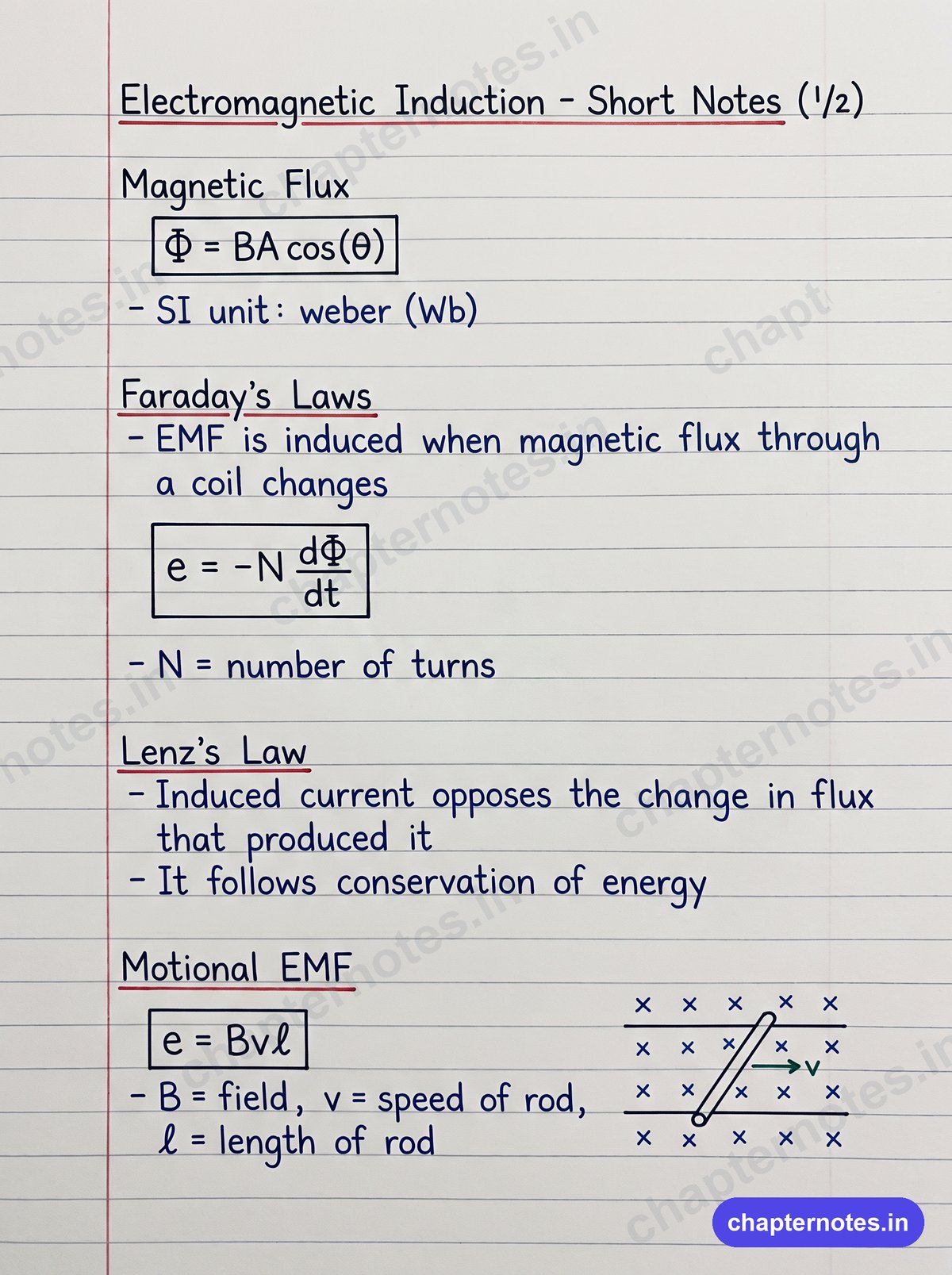
1. Magnetic Flux
Magnetic flux (Φ) through a surface is the total number of magnetic field lines passing through it.
Φ = B · A = BA cos θ
Unit: Weber (Wb) = T·m²
2. Faraday’s Laws of Electromagnetic Induction
First Law: Whenever the magnetic flux linked with a circuit changes, an EMF is induced in the circuit.
Second Law: The magnitude of induced EMF is equal to the rate of change of magnetic flux:
ε = −dΦ/dt
For a coil of N turns: ε = −N(dΦ/dt)
The negative sign represents Lenz’s law.
Ways to Change Flux (and Induce EMF)
- Change the magnetic field strength (B)
- Change the area of the loop (A)
- Change the angle between B and the normal to the loop (θ)
- Move the conductor in the field
3. Lenz’s Law
The direction of the induced current is such that it opposes the change in flux that produced it.
This is a consequence of the law of conservation of energy. If the induced current aided the change, it would create a perpetual motion machine - which is impossible.
4. Motional EMF
When a conductor of length l moves with velocity v perpendicular to a magnetic field B:
ε = Blv
This is because the magnetic force on the free electrons in the conductor creates a potential difference.
5. Self-Inductance
When current through a coil changes, the changing magnetic flux induces an EMF in the same coil that opposes the change.
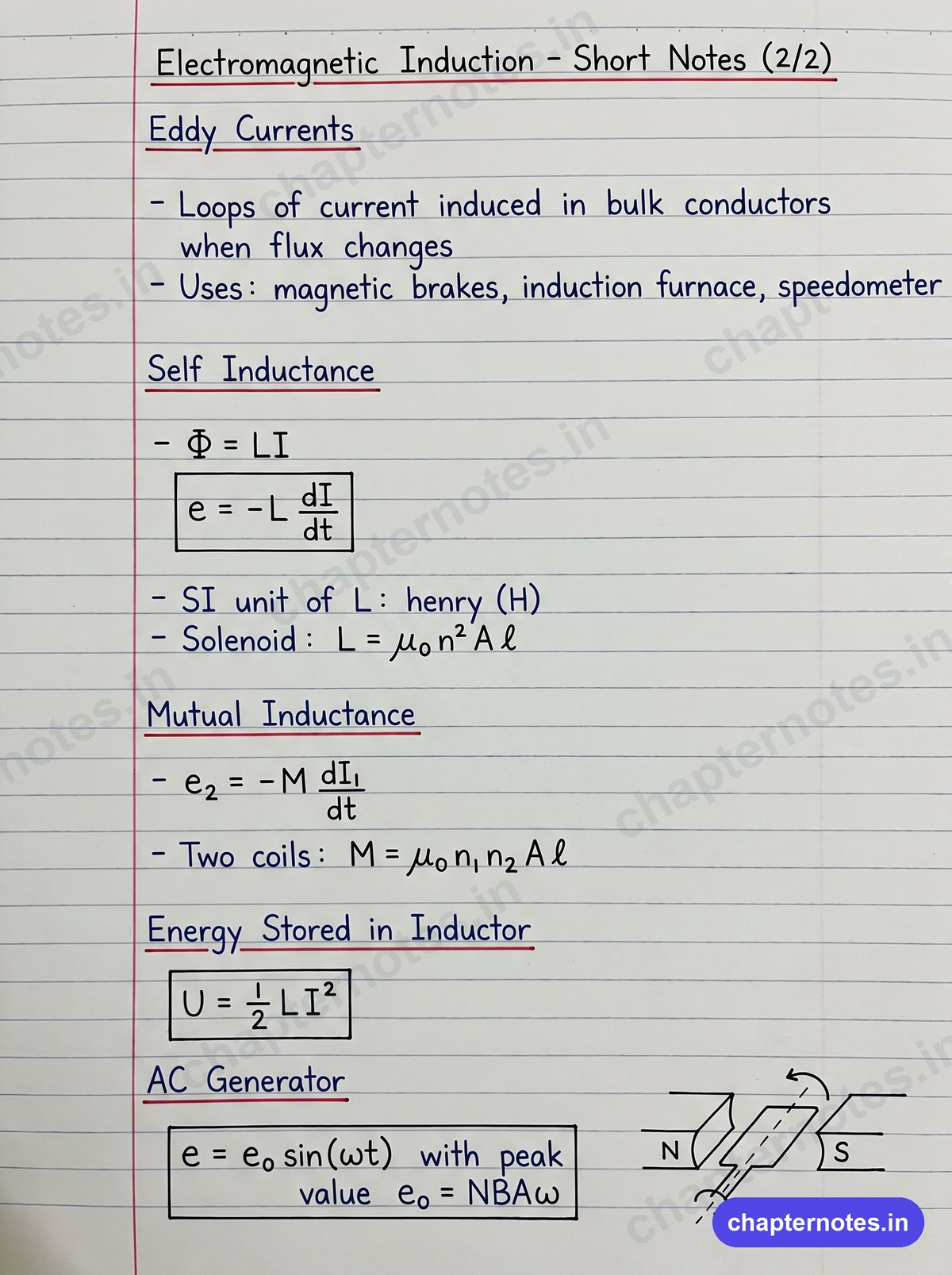
ε = −L(dI/dt)
L = NΦ/I (self-inductance, unit: Henry, H)
For a solenoid: L = μ₀n²Al (n = turns per unit length, A = area, l = length)
Energy stored in an inductor: U = ½LI²
6. Mutual Inductance
When current in one coil changes, the changing flux induces an EMF in a nearby coil.
ε₂ = −M(dI₁/dt)
M = coefficient of mutual inductance (unit: Henry)
For two coaxial solenoids: M = μ₀n₁n₂Al
7. Eddy Currents
Eddy currents are loops of current induced in bulk conductors when exposed to changing magnetic fields.
Applications: Electromagnetic braking (trains), induction furnace, speedometers, electromagnetic damping
Disadvantage: Energy loss as heat in transformer cores. Minimised by using laminated cores.
Important Definitions
| Term | Definition |
|---|---|
| Magnetic flux | Φ = BA cos θ - total field lines through a surface (unit: Weber) |
| Electromagnetic induction | Production of EMF due to changing magnetic flux |
| Lenz’s law | Induced current opposes the change in flux that caused it |
| Self-inductance (L) | Property of a coil to oppose change in its own current; ε = −LdI/dt |
| Mutual inductance (M) | EMF induced in one coil due to changing current in another nearby coil |
| Eddy currents | Circulating currents induced in bulk conductors by changing magnetic fields |
Read the rest of the chapter →Hide the rest ↑
Solved Examples
Example 1
A coil of 100 turns has flux changing from 0.02 Wb to 0.04 Wb in 0.1 s. Find the induced EMF.
Answer: ε = N(ΔΦ/Δt) = 100 × (0.04 − 0.02)/0.1 = 100 × 0.2 = 20 V
Example 2
A rod of length 50 cm moves at 4 m/s perpendicular to a field of 0.5 T. Find the motional EMF.
Answer: ε = Blv = 0.5 × 0.5 × 4 = 1 V
Example 3
A solenoid of self-inductance 2 H carries a current of 3 A. Find the energy stored.
Answer: U = ½LI² = ½ × 2 × 9 = 9 J
Example 4
The mutual inductance of two coils is 0.5 H. If the current in the first coil changes at 10 A/s, find the EMF in the second coil.
Answer: ε = M(dI/dt) = 0.5 × 10 = 5 V
Important Questions for Board Exams
1-Mark
- State Lenz’s law.
- What is the SI unit of self-inductance?
3-Mark
- State Faraday’s laws of electromagnetic induction. Give one application.
- Derive the expression for motional EMF.
- What are eddy currents? Give two applications and one disadvantage.
5-Mark
- Derive the expression for self-inductance of a long solenoid. Also find the energy stored.
- State and explain Faraday’s laws and Lenz’s law. Show that Lenz’s law is a consequence of conservation of energy.
Quick Revision Points
- Φ = BA cos θ; ε = −NdΦ/dt (Faraday’s law)
- Lenz’s law: induced current opposes the cause (conservation of energy)
- Motional EMF: ε = Blv
- Self-inductance: ε = −LdI/dt; L = μ₀n²Al (solenoid); U = ½LI²
- Mutual inductance: ε₂ = −MdI₁/dt
- Eddy currents: used in braking, induction furnace; minimised by lamination
Previous: Ch 5 - Magnetism and Matter
Next: Ch 7 - Alternating Current
Class 12 Physics · Chapter 6 – swipe through all 10 cards to understand the whole chapter.
Magnetic Flux
Flux counts how many field lines pass through a surface.
θ is from the area normal, not the surface. Unit: weber (Wb) = T·m2
- Max when B ⊥ surface (θ = 0); zero when B ∥ surface (θ = 90°)
- Trap: angle with plane → angle with normal = 90° − that
- For N turns, total linkage = N Φ_B
Faraday’s Law
A changing flux induces an EMF; a steady flux induces nothing.
Faster change → bigger EMF. N turns → N× the EMF.
- Only a CHANGE in flux drives induction
- Flux changes 3 ways: change B, change A, or rotate (change θ)
- Magnitude = N · ΔΦ_B / Δt for uniform change
Lenz’s Law
The induced current opposes the very change that caused it.
This is just energy conservation — no free energy.
- Flux increasing → current opposes; decreasing → current maintains it
- Magnet pushed in is repelled; pulled out is attracted
- You must do work; that work becomes the electrical energy
Induced Charge
Total charge depends only on flux change and resistance, not speed.
Fast or slow gives the same CHARGE; only current/EMF differ.
- Derived from ε = IR and q = ∫I dt
- Path-independent — only ΔΦ_B and R matter
- Common MCQ: same q whether magnet moves quick or slow
Motional EMF
A rod sliding through a field becomes a tiny battery.
Only the v-component ⊥ to both B and rod counts; if v ∥ B, ε = 0.
- Same as Faraday’s law: rod sweeps area at rate l·v
- On rails of resistance R, induced current I = B v l / R
- It is a real EMF source even in a steady field
Retarding Force on the Rod
The induced current makes the field push back on the moving rod.
F ∝ v but power dissipated ∝ v2. Mechanical power → heat in R.
- Force opposes motion (Lenz’s law): F = B I l
- Power supplied by the pusher equals ε2/R dissipated
- Rotating rod about one end: ε = ½ B ω l2
Eddy Currents
Changing flux sets up looping currents inside solid metal.
Reduce losses with LAMINATED cores (thin insulated sheets).
- Uses: electromagnetic braking, induction furnace/cooktop, dead-beat galvanometer
- Magnet falls slowly through a copper pipe — eddy currents damp it
- Lamination raises path resistance, cutting eddy heat loss
Self-Inductance
A coil opposes changes in its OWN current via a back-EMF.
L depends on geometry/core only, not on current. Unit: henry (H).
- Long solenoid: L = μ0 N2 A / l (so L ∝ N2 — double N → 4× L)
- Energy stored: U = ½ L I2 (magnetic analogue of ½ C V2)
- Inductor = electrical inertia; resists sudden current change
Mutual Inductance
Changing current in one coil induces an EMF in a neighbour.
M is symmetric: M12 = M21. Unit: henry (H). 0 ≤ k ≤ 1.
- Coaxial solenoids: M = μ0 N1 N2 A / l
- k = 1 means perfect coupling (all flux links both coils)
- Working principle of the transformer
AC Generator
Rotating a coil in a field continuously changes flux → alternating EMF.
Output is sinusoidal; peak EMF ε0 rises with N, B, A and speed ω.
- Direct use of Faraday’s law with θ = ωt, so Φ = N B A cos(ωt)
- Converts mechanical energy into electrical energy
- EMF is zero when coil plane ⊥ B (flux max), peak when coil plane ∥ B
📝 Practice Electromagnetic Induction — 10 NEET PYQs
Real previous-year questions · with answers & solutions
Start →Close ✕
Chapter Navigation
Previous: Magnetism and Matter Class 12 Notes
Next: Alternating Current Class 12 Notes
Related Chapters in Class 12 Physics
- Alternating Current Class 12 Notes
- Moving Charges and Magnetism Class 12 Notes
- Magnetism and Matter Class 12 Notes
Practice What You Learned
Test yourself with our JEE Main Mock Test Set 1 to see how well you’ve mastered the concepts.
Explore More
Frequently Asked Questions
Magnetic flux is a measure of how much magnetic field passes through a surface. For a uniform field B through area A, flux equals B times A times cosine of the angle between B and the area vector (the normal). Its SI unit is the weber (Wb), where one weber equals one tesla times one square metre.
Faraday’s law states that the induced EMF equals the negative rate of change of magnetic flux linkage, so a changing flux induces an EMF. Lenz’s law explains the negative sign: the induced current flows in a direction that opposes the change that produced it, which is a consequence of conservation of energy.
Motional EMF is the EMF induced in a conductor moving through a magnetic field. For a rod of length l moving with velocity v perpendicular to a field B, the induced EMF equals B times v times l. It is just Faraday’s law applied to a conductor sweeping area in the field.
Self-inductance is the property of a coil to oppose a change in its own current by inducing a back-EMF, measured in henry and depending only on geometry and core material. Mutual inductance is the EMF induced in one coil due to a changing current in a neighbouring coil, and it is symmetric, meaning it is the same whichever coil carries the current.
Eddy currents are loops of induced current set up in the body of a solid conductor when the magnetic flux through it changes, and by Lenz’s law they oppose the change and dissipate energy as heat. They are used in electromagnetic braking, induction furnaces, induction cooktops and dead-beat galvanometers, and are reduced by laminating cores.
