
Current Electricity (Class 12 Physics) is about how electric charge flows through conductors and the laws that govern it. Electric current is the rate of flow of charge, I = Q/t, measured in amperes. Ohm’s law states V = IR, where resistance R = rho L/A depends on the material and dimensions of the conductor. Drift velocity, resistivity, internal resistance of a cell, and Kirchhoff’s two rules (junction and loop) let you solve any circuit, and a Wheatstone bridge or potentiometer measures unknown resistances and EMFs precisely. Key formulas: I = nAev_d, V = IR, P = VI = I^2 R = V^2/R, and EMF = V + Ir.
Key Concepts
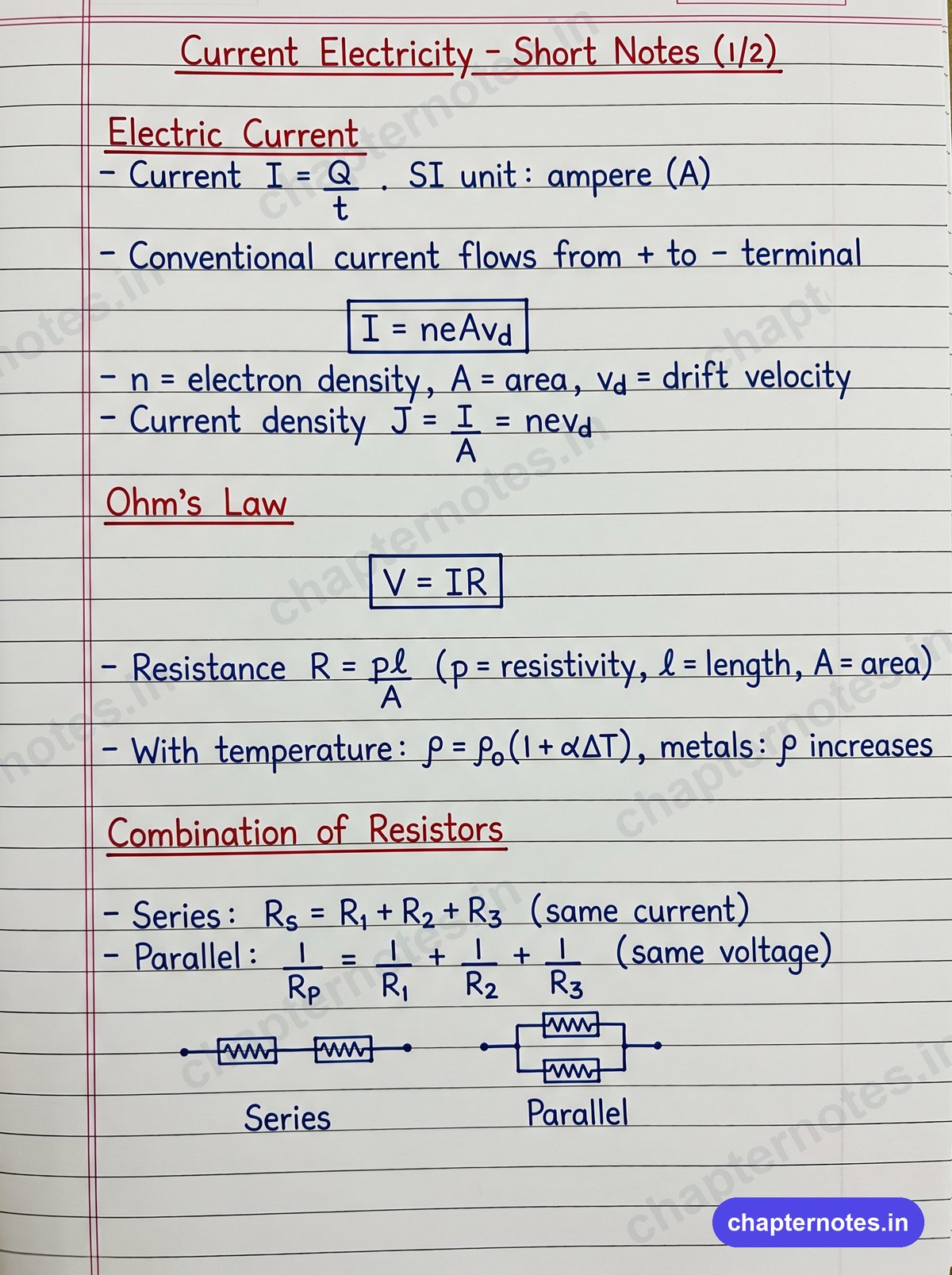
1. Electric Current
Electric current is the rate of flow of charge: I = dQ/dt
Unit: Ampere (A). 1 A = 1 C/s
Conventional current flows from higher potential (+) to lower potential (−). Electron flow is in the opposite direction.
Drift Velocity
When a potential difference is applied, free electrons in a conductor drift slowly towards the positive terminal. This average velocity is called drift velocity (vd).
I = neAvd
- n = number density of free electrons (per m³)
- e = charge of electron
- A = cross-sectional area
- vd = drift velocity (typically ~10⁻⁴ m/s - very slow!)
Current Density
J = I/A = nevd (unit: A/m²)
2. Ohm’s Law and Resistance
Ohm’s Law: V = IR (at constant temperature)
Resistance: R = V/I = ρl/A
- ρ = resistivity of the material (unit: Ω·m)
- l = length of conductor
- A = cross-sectional area
Temperature Dependence
For metals: ρ = ρ₀(1 + αΔT) - resistivity increases with temperature
For semiconductors: resistivity decreases with temperature (more carriers generated)
Colour Code for Resistors
Bands: Black(0), Brown(1), Red(2), Orange(3), Yellow(4), Green(5), Blue(6), Violet(7), Grey(8), White(9)
3. Combinations of Resistors
| Feature | Series | Parallel |
|---|---|---|
| Current | Same | Divides |
| Voltage | Divides | Same |
| Equivalent R | R = R₁ + R₂ + … | 1/R = 1/R₁ + 1/R₂ + … |
4. Cells and Internal Resistance
A real cell has an EMF (ε) and an internal resistance (r).
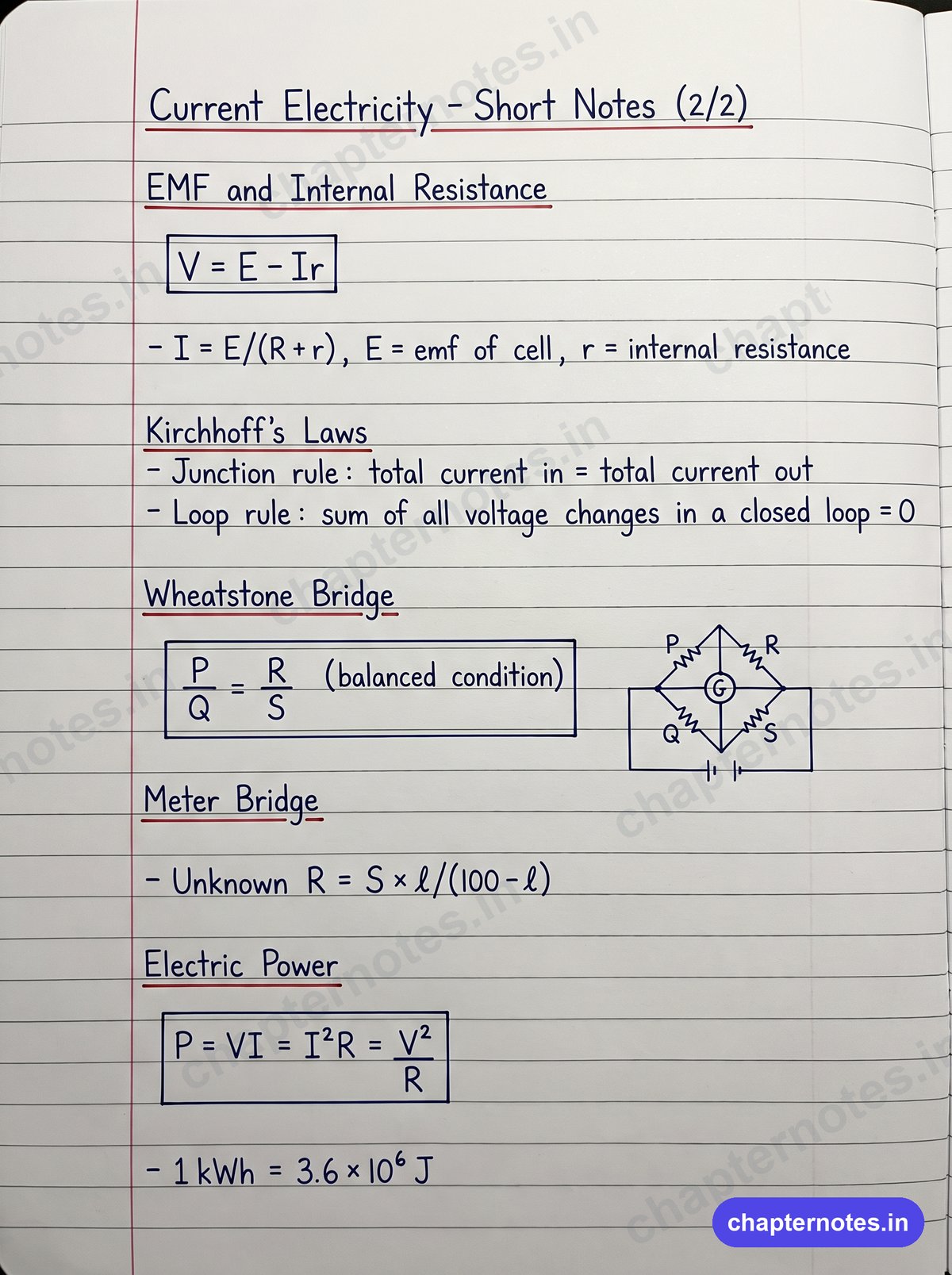
Terminal voltage: V = ε − Ir (when current is drawn)
When no current flows (open circuit): V = ε
Combination of Cells
| Type | EMF | Internal Resistance | Best for |
|---|---|---|---|
| Series (n cells) | nε | nr | High EMF needed (external R >> internal r) |
| Parallel (n cells) | ε | r/n | More current needed (external R << internal r) |
5. Kirchhoff’s Laws
Junction Rule (KCL - Kirchhoff’s Current Law)
The sum of currents entering a junction equals the sum of currents leaving it. (Based on conservation of charge)
ΣI_in = ΣI_out
Loop Rule (KVL - Kirchhoff’s Voltage Law)
The algebraic sum of potential differences around any closed loop is zero. (Based on conservation of energy)
ΣV = 0 around any closed loop
6. Wheatstone Bridge
A Wheatstone bridge is a circuit with four resistors arranged in a diamond shape. When the bridge is balanced, no current flows through the galvanometer.
Balance condition: P/Q = R/S
7. Meter Bridge
A practical form of Wheatstone bridge using a 1 m wire. At balance:
R/S = l/(100 − l)
where l is the balancing length from one end.
8. Potentiometer
A device for measuring EMF accurately (draws no current from the source).
- Compares EMFs: ε₁/ε₂ = l₁/l₂
- Measures internal resistance: r = R(l₁ − l₂)/l₂
Weightage in Board & Entrance Exams
| Exam | Typical Weightage | Most-Tested Areas |
|---|---|---|
| CBSE Board (Class 12) | 7–9 marks | Ohm's law, resistor networks, Kirchhoff's laws, potentiometer, Wheatstone bridge |
| JEE Main / Advanced | 2–3 questions | Equivalent resistance, cells in series/parallel, meter bridge, RC ideas |
| NEET | 2–3 questions | Drift velocity, resistivity, Wheatstone balance, internal resistance |
Important Definitions
| Term | Definition |
|---|---|
| Electric current | Rate of flow of charge: I = dQ/dt |
| Drift velocity | Average velocity of free electrons in a conductor under applied field |
| Resistivity | Material property that determines resistance: R = ρl/A |
| EMF | Work done per unit charge by the cell in moving charge through the complete circuit |
| Internal resistance | Resistance offered by the electrolyte and electrodes inside the cell |
| Kirchhoff’s junction rule | Sum of currents at a junction = 0 (conservation of charge) |
| Kirchhoff’s loop rule | Sum of potential differences in a closed loop = 0 |
| Wheatstone bridge | Circuit of four resistors; balanced when P/Q = R/S |
Read the rest of the chapter →Hide the rest ↑
Solved Examples
Example 1
A cell of EMF 2 V and internal resistance 0.5 Ω is connected to a 3.5 Ω resistor. Find the current and terminal voltage.
Answer: I = ε/(R + r) = 2/(3.5 + 0.5) = 2/4 = 0.5 A. Terminal voltage: V = ε − Ir = 2 − 0.5 × 0.5 = 1.75 V.
Example 2
In a Wheatstone bridge, P = 100 Ω, Q = 200 Ω, R = 150 Ω. Find S for balance.
Answer: P/Q = R/S → 100/200 = 150/S → S = 150 × 200/100 = 300 Ω.
Example 3
In a meter bridge, the null point is at 40 cm. If R = 10 Ω, find S.
Answer: R/S = l/(100 − l) → 10/S = 40/60 → S = 10 × 60/40 = 15 Ω.
Example 4
A copper wire of length 2 m and cross-section 1 mm² has resistivity 1.7 × 10⁻⁸ Ω·m. Find its resistance.
Answer: R = ρl/A = (1.7 × 10⁻⁸ × 2)/(1 × 10⁻⁶) = 3.4 × 10⁻⁸/10⁻⁶ = 0.034 Ω.
Example 5
Q. In a Wheatstone bridge P = 10 Ω, Q = 20 Ω and R = 15 Ω. Find S for a balanced bridge.
A. At balance P/Q = R/S, so S = R×Q/P = 15×20/10 = 30 Ω.
Example 6
Q. Two resistors 6 Ω and 3 Ω are connected in parallel. What is their equivalent resistance?
A. 1/Rₚ = 1/6 + 1/3 = 1/6 + 2/6 = 3/6, so Rₚ = 2 Ω (always less than the smallest resistor).
Important Questions for Board Exams
1-Mark Questions
- State Kirchhoff’s junction rule.
- What is the condition for balance in a Wheatstone bridge?
- Why is a potentiometer preferred over a voltmeter for measuring EMF?
3-Mark Questions
- Derive the relation I = neAvd for drift velocity.
- State and explain Kirchhoff’s laws. Use them to find the current in a given circuit.
- Explain how a meter bridge works. Derive the formula for unknown resistance.
5-Mark Questions
- Define resistivity. Derive the expression for equivalent resistance in series and parallel combinations.
- Explain the working of a potentiometer. How can it be used to compare EMFs of two cells?
Quick Revision Points
- I = dQ/dt; I = neAvd; drift velocity is very slow (~10⁻⁴ m/s)
- Ohm’s law: V = IR; Resistance: R = ρl/A
- Temperature: metals R↑, semiconductors R↓
- Cell: V = ε − Ir; Series: nε, nr; Parallel: ε, r/n
- KCL: ΣI = 0 at junction; KVL: ΣV = 0 in loop
- Wheatstone balance: P/Q = R/S
- Meter bridge: R/S = l/(100 − l)
- Potentiometer: ε₁/ε₂ = l₁/l₂ (no current drawn - accurate)
Previous Chapter: Chapter 2 - Electrostatic Potential and Capacitance
Next Chapter: Chapter 4 - Moving Charges and Magnetism
In a potentiometer circuit, a cell of EMF 1.5 V gives a balance point at 36 cm length of wire. If a cell of EMF 2.5 V replaces the first cell, the balance point occurs at:
60 cm
21.6 cm
64 cm
62 cm
With a constant potential gradient, the balancing length is proportional to EMF: (L₁)/(L₂) = (ε₁)/(ε₂) → L₂ = 36×(2.5)/(1.5) = 60 cm.
The colour code on a carbon resistor is Yellow, Violet, Brown, Gold (in order). Its resistance and tolerance are:
47 kΩ, 10%
4.7 kΩ, 5%
470 Ω, 5%
470 kΩ, 5%
Carbon-resistor code: Yellow = 4, Violet = 7, so the first two digits give 47. Brown is the multiplier 10¹, giving 47×10¹ = 470 Ω. Gold tolerance band = ±5%. So the resistor is 470 Ω, 5%.
n resistors, each of r ohm, when connected in parallel give an equivalent resistance of R ohm. If these resistances are instead connected in series, the combination’s resistance equals:
n²R
(R)/(n²)
(R)/(n)
nR
In parallel, R = r/n, so r = nR. In series, Rₛ = nr = n(nR) = n²R.
If the voltage across a bulb rated ‘220 V, 100 W’ drops by 2.5% of its rated value, the percentage by which the power decreases is (assume constant resistance):
20%
2.5%
5%
10%
Since P = V²/R with R constant, (Δ P)/(P) = 2(Δ V)/(V). For a 2.5% drop in V, the power decreases by 2×2.5% = 5%.
The resistance of a wire is R ohm. If it is melted and stretched to n times its original length, its new resistance is:
nR
(R)/(n)
n²R
(R)/(n²)
Melting and redrawing conserves volume, so when length becomes nL the area becomes A/n. Since R = ρ L/A, the new resistance R’ = ρ(nL)/(A/n) = n² ρ(L)/(A) = n²R.
Class 12 Physics · Chapter 3 – swipe through all 10 cards to understand the whole chapter.
Electric Current
Rate of flow of charge through a cross-section of a conductor.
Unit: ampere (A) · scalar
- Direction = flow of +ve charge
- Steady current: constant I
- 1 A = 1 C/s
Drift Velocity
Average velocity electrons gain along the wire under a field.
v_d = (eE/m)·τ
- Tiny (~10⁻4 m/s)
- n = electrons per unit volume
- τ = relaxation time
Ohm’s Law & Resistance
Current is proportional to voltage for an ohmic conductor.
ρ = resistivity (Ω·m)
- R rises with length L
- R falls with area A
- Unit of R: ohm (Ω)
Resistivity & Temperature
Resistivity of a metal increases with temperature.
α = temperature coefficient
- Metals: α positive
- Semiconductors: α negative
- Superconductors: ρ → 0
Combination of Resistors
How resistance adds when resistors are joined.
Series same I · Parallel same V
- Series R > largest
- Parallel R < smallest
- Opposite of capacitors
EMF & Internal Resistance
A real cell loses some voltage across its own resistance r.
E = emf, V = terminal voltage
- V < E while discharging
- V = E on open circuit
- Short circuit I = E/r
Kirchhoff’s Laws
Two conservation rules to solve any circuit network.
Junction (charge) · Loop (energy)
- KCL: ΣI in = ΣI out
- KVL: ΣEMF = ΣIR in a loop
- Sign convention matters
Wheatstone Bridge
A network to measure an unknown resistance at balance.
Galvanometer reads zero
- No current through bridge arm
- Basis of the meter bridge
- Most sensitive when arms equal
Potentiometer
Measures potential difference without drawing current.
Balancing length l
- More accurate than a voltmeter
- Draws zero current at balance
- Compares EMFs of two cells
Electric Power
Rate at which electrical energy is converted in a device.
Unit: watt (W) · H = I2Rt
- Heating: Joule’s law
- Bulb rating = P at rated V
- 1 kWh = 1 ‘unit’
📝 Practice Current Electricity — 10 NEET PYQs
Real previous-year questions · with answers & solutions
Start →Close ✕
Chapter Navigation
Previous: Electrostatic Potential and Capacitance Class 12 Notes
Next: Moving Charges and Magnetism Class 12 Notes
Related Chapters in Class 12 Physics
- Electric Charges and Fields Class 12 Notes
- Electrostatic Potential and Capacitance Class 12 Notes
- Moving Charges and Magnetism Class 12 Notes
Practice What You Learned
Test yourself with our JEE Main Mock Test Set 1 to see how well you’ve mastered the concepts.
Explore More
Frequently Asked Questions
Ohm’s law and resistance, series and parallel combinations of resistors, cells and internal resistance, Kirchhoff’s laws, the Wheatstone bridge, the meter bridge and the potentiometer. Drift velocity and resistivity-temperature dependence are frequent 1-mark and assertion-reason questions.
Yes - it is one of the highest-weightage Class 12 Physics chapters in both exams. Numericals on Kirchhoff’s laws, internal resistance and resistor combinations appear almost every year.
Yes. The notes end with 1-mark, 3-mark and 5-mark important questions, four solved examples and quick revision points covering the formulas CBSE asks most often.
Yes - they follow NCERT Class 12 Physics Chapter 3 (Current Electricity) as per the current CBSE syllabus, written as short notes for quick revision.
