
Class 12 Maths · Chapter 4 – swipe through all 6 cards to understand the whole chapter.
What is a Determinant?
A single number associated with a square matrix.
Written det(A) or |A|
- Only for square matrices
- 3×3 by expansion
- |A| can be + , − or 0
Minors & Cofactors
Expand a determinant along any row or column.
M = minor, C = cofactor
- Minor: delete row i, col j
- Sign board: + − + …
- |A| = Σ aᵢⱼ Cᵢⱼ
Properties of Determinants
Properties that simplify evaluation.
|AB| = |A||B|
- Two equal rows → 0
- Common factor pulls out
- |Aᵀ| = |A|
Area of a Triangle
Determinant gives the area from three vertices.
Collinear ⇒ area = 0
- Take absolute value
- Order of points: any
- Collinearity test
Adjoint & Inverse
Invert a matrix using its adjoint.
Only if |A| ≠ 0
- adj = transpose of cofactors
- |A| = 0 ⇒ singular (no inverse)
- A·adj(A) = |A| I
System of Equations (AX = B)
Solve linear systems using determinants.
Cramer: x = Δ1/Δ
- |A| ≠ 0: unique solution
- |A| = 0: no / infinite solutions
- Consistent vs inconsistent
Determinants (Class 12 Maths) assigns a single number to a square matrix that tells you whether it is invertible and helps solve systems of linear equations. For a 2×2 matrix the determinant is ad - bc; for a 3×3 matrix you expand along a row or column using cofactors. Key uses are finding the area of a triangle from coordinates, testing whether a matrix is singular (det = 0), computing the inverse via the adjoint (A inverse = adj A / det A), and solving equations by Cramer’s rule. Important properties: swapping two rows changes the sign, and a common factor of a row can be taken outside the determinant.
Download Determinants Class 12 Notes PDF (Free)
Print-friendly branded PDF - save it, print it, or share it with friends. No sign-up needed.
📥 Download PDF (Free)Chapter 4 - Determinants - covers evaluation, properties, area of triangles, adjoint, inverse of matrices, and solving linear equations using Cramer’s rule. Carries 8-10 marks - one of the highest-scoring chapters.
Key Concepts
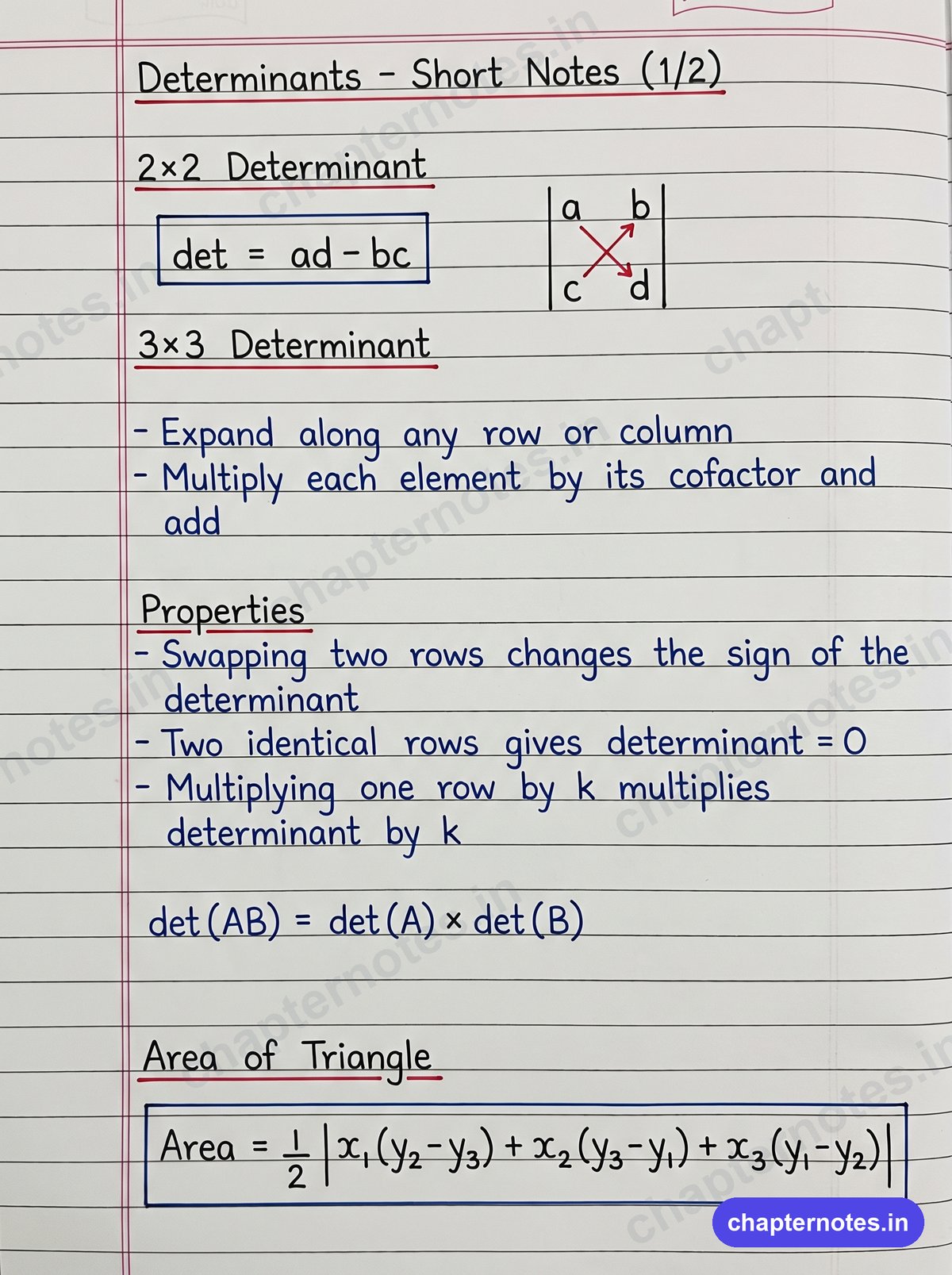
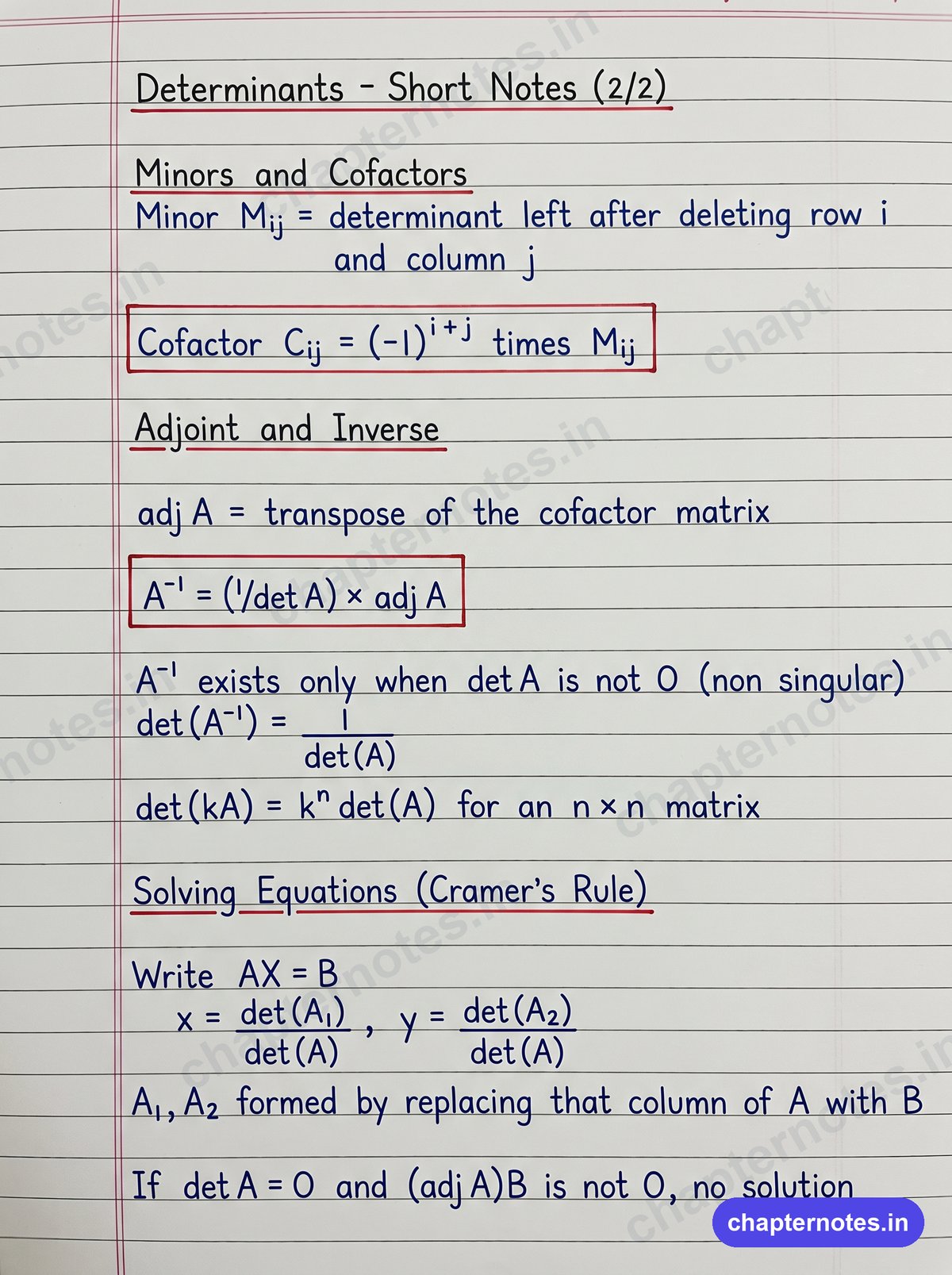
Determinant Evaluation
3×3 (expansion along R₁):
|A| = a₁₁(A₁₁) − a₁₂(A₁₂) + a₁₃(A₁₃)
Where Aᵢⱼ = (−1)^(i+j) × Mᵢⱼ (cofactor), Mᵢⱼ = minor
Properties of Determinants
- |Aᵀ| = |A|
- Interchanging rows/columns changes sign
- Two identical rows/columns → |A| = 0
- Scalar multiplication of a row: multiplies determinant by that scalar
- |kA| = kⁿ|A| for n×n matrix
- Row/column operation Rᵢ → Rᵢ + kRⱼ doesn’t change value
- |AB| = |A| × |B|
Area of Triangle
Or using determinant: Area = ½|[x₁ y₁ 1; x₂ y₂ 1; x₃ y₃ 1]|
Points are collinear if Area = 0
Adjoint and Inverse
A⁻¹ = (1/|A|) × adj(A) (exists only when |A| ≠ 0)
Properties: A × adj(A) = |A| × I
|adj(A)| = |A|ⁿ⁻¹ (for n×n matrix)
(AB)⁻¹ = B⁻¹A⁻¹
System of Linear Equations (AX = B)
Cramer’s Rule:
x = D₁/D, y = D₂/D, z = D₃/D
Where D = |A|, D₁ = |A with column 1 replaced by B|, etc.
If |A| = 0: system is either inconsistent (no solution) or has infinite solutions
Solved Examples
Example 1
Q: Find the inverse of A = [2 3; 1 4]
Solution:
|A| = 8−3 = 5 ≠ 0 → inverse exists
adj(A) = [4 −3; −1 2]
A⁻¹ = (1/5)[4 −3; −1 2] = [4/5 −3/5; −1/5 2/5]
Example 2
Q: Using determinants, find the area of triangle with vertices (1,0), (6,0), (4,3).
Solution: Area = ½|1(0−3) + 6(3−0) + 4(0−0)| = ½|−3 + 18 + 0| = ½(15) = 7.5 sq units
Quick Revision Points
- 2×2: ad−bc; 3×3: expand along any row/column
- |kA| = kⁿ|A|; |AB| = |A||B|; |Aᵀ| = |A|
- A⁻¹ = adj(A)/|A|; exists only if |A| ≠ 0 (non-singular)
- Cramer’s rule: x = D₁/D, y = D₂/D, z = D₃/D
- Area of triangle using determinant = ½|det|; collinear if = 0
Chapter Navigation
Previous: Matrices Class 12 Notes
Next: Continuity and Differentiability Class 12 Notes
Related Chapters in Class 12 Maths
- Matrices Class 12 Notes
- Relations and Functions Class 12 Notes
- Continuity and Differentiability Class 12 Notes
Practice What You Learned
Test yourself with our JEE Main Mock Test Set 1 to see how well you’ve mastered the concepts.
Explore More
Frequently Asked Questions
A determinant is a single number associated with a square matrix that tells you whether the matrix is invertible and helps solve linear equations. For a 2×2 matrix [[a, b], [c, d]] it is ad - bc, and for a 3×3 matrix it is found by expanding along any row or column using cofactors.
Pick any row or column, multiply each element by its cofactor (the signed minor), and add the results. The sign pattern alternates as plus, minus, plus. Choosing a row or column with zeros makes the expansion quicker.
A square matrix A has an inverse only if its determinant is non-zero. The inverse is A inverse = adj A divided by det A, where adj A is the adjoint (the transpose of the cofactor matrix). If det A = 0 the matrix is singular and has no inverse.
The area of a triangle with vertices (x1, y1), (x2, y2), (x3, y3) is half the absolute value of the determinant formed from these coordinates. If the determinant is zero, the three points are collinear, meaning they lie on a straight line.
Swapping two rows or columns changes the sign of the determinant; if two rows or columns are identical the determinant is zero; a common factor of a row or column can be taken outside; and the determinant is unchanged if a multiple of one row is added to another. These properties simplify evaluation.
