
Laws of Motion builds on Newton’s three laws to explain why objects start, stop, speed up, or change direction, linking force to momentum through F = ma and F = dp/dt. It also covers friction, impulse, equilibrium, and conservation of momentum, the ideas behind everyday recoil, collisions, and motion on inclines. It is a high-yield mechanics chapter for NEET, supplying both direct concept questions and the force-balance setups you reuse across the whole physics paper.
Table of Contents
- Key Concepts — Inertia, the three laws, momentum, impulse, friction, circular motion
- Weightage in Board & Entrance Exams
- Important Definitions
- Solved Examples
- Important Questions for Board Exams
- Quick Revision Points
Key Concepts
1. Force and Inertia
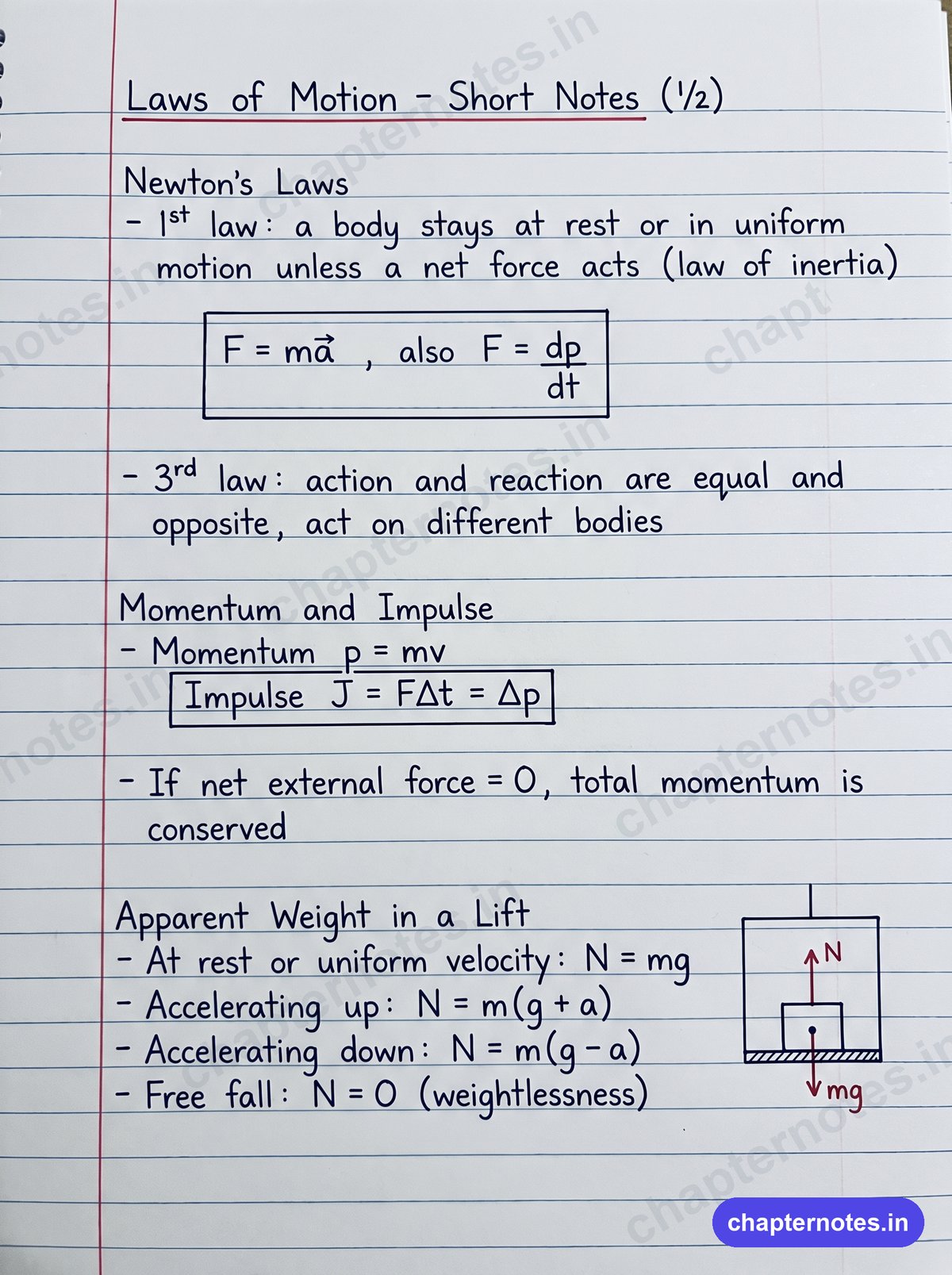
A force is a push or a pull that can change the state of rest or of uniform motion of a body, or change its shape. SI unit: newton (N). Force is a vector quantity.
Inertia is the natural tendency of a body to resist any change in its state of rest or of uniform motion. A heavier body has more inertia — that is why it is harder to push a loaded trolley than an empty one.
Three Types of Inertia
- Inertia of rest: a body at rest stays at rest (dust falls off a carpet when you beat it).
- Inertia of motion: a moving body keeps moving (a passenger lurches forward when a bus brakes suddenly).
- Inertia of direction: a body resists change in its direction of motion (mud flies off tangentially from a spinning wheel).
2. Newton’s First Law of Motion (Law of Inertia)
A body continues in its state of rest or of uniform motion in a straight line unless acted upon by an external unbalanced force.
The first law gives us the qualitative definition of force (force is what changes a body’s state of motion) and defines inertia. If the net force is zero, acceleration is zero — the body is in equilibrium.
Key idea: No net force is needed to keep a body moving at constant velocity — only to change its velocity.
3. Linear Momentum
Linear momentum (p) is the quantity of motion contained in a body. It is the product of mass and velocity.
p = mv
- SI unit: kg·m/s (or N·s)
- It is a vector quantity, in the direction of velocity.
- A heavy slow truck and a light fast bullet can have the same momentum.
4. Newton’s Second Law of Motion
The rate of change of momentum of a body is directly proportional to the applied force and takes place in the direction of the force.
F = dp/dt = d(mv)/dt = ma (for constant mass)
- This is the quantitative definition of force.
- 1 newton = the force that gives a 1 kg mass an acceleration of 1 m/s².
- Acceleration is along the direction of the net force.
The second law contains the first law as a special case: if F = 0, then a = 0, so velocity is constant.
5. Impulse
Impulse is the product of a force and the time for which it acts. It equals the change in momentum of the body (the impulse-momentum theorem).
Impulse J = F × Δt = Δp = m(v − u)
- SI unit: N·s or kg·m/s
- It is a vector quantity.
- This is why cricketers pull their hands back while catching a ball — increasing Δt reduces the force F felt for the same change in momentum.
6. Newton’s Third Law of Motion
To every action there is an equal and opposite reaction. Action and reaction act on two different bodies, are equal in magnitude, opposite in direction, and act simultaneously.
- A gun recoils when a bullet is fired.
- A swimmer pushes water backward; water pushes the swimmer forward.
- A rocket expels gas downward; the gas pushes the rocket upward.
Important: Action and reaction never cancel out because they act on different bodies.
7. Law of Conservation of Linear Momentum
If the net external force on a system is zero, the total linear momentum of the system remains constant.
m₁u₁ + m₂u₂ = m₁v₁ + m₂v₂
This law is a direct consequence of Newton’s second and third laws. It is the principle behind recoil of a gun, rocket propulsion, and collisions.
Recoil of a Gun
If a gun of mass M fires a bullet of mass m with velocity v, the recoil velocity V of the gun is:
V = −mv/M (negative sign shows the gun moves opposite to the bullet)
8. Free-Body Diagrams (FBD)
A free-body diagram is a sketch showing a single body isolated from its surroundings with all the external forces acting on it drawn as arrows.
[DIAGRAM: A block on a table — weight mg downward, normal reaction N upward, applied force F horizontal, friction f opposite to motion.]
Common Forces in an FBD
- Weight (W = mg): always acts vertically downward.
- Normal reaction (N): perpendicular to the surface of contact.
- Tension (T): along a string, pulling away from the body.
- Friction (f): along the surface, opposing relative motion.
Method: Isolate the body → draw all forces → choose axes → apply ΣFₓ = maₓ and ΣF_y = ma_y.
9. Equilibrium of Concurrent Forces
A body is in equilibrium when the net force on it is zero, so it has zero acceleration (either at rest or moving with constant velocity).
Condition: ΣFₓ = 0 and ΣF_y = 0
For three concurrent forces in equilibrium, the Lami’s theorem applies:
F₁/sin α = F₂/sin β = F₃/sin γ
where α, β, γ are the angles opposite to forces F₁, F₂, F₃ respectively.
10. Friction
Friction is the force that opposes relative motion (or tendency of motion) between two surfaces in contact. It acts along the surfaces, opposite to the direction of motion.
Types of Friction
| Type | Description | Relation |
|---|---|---|
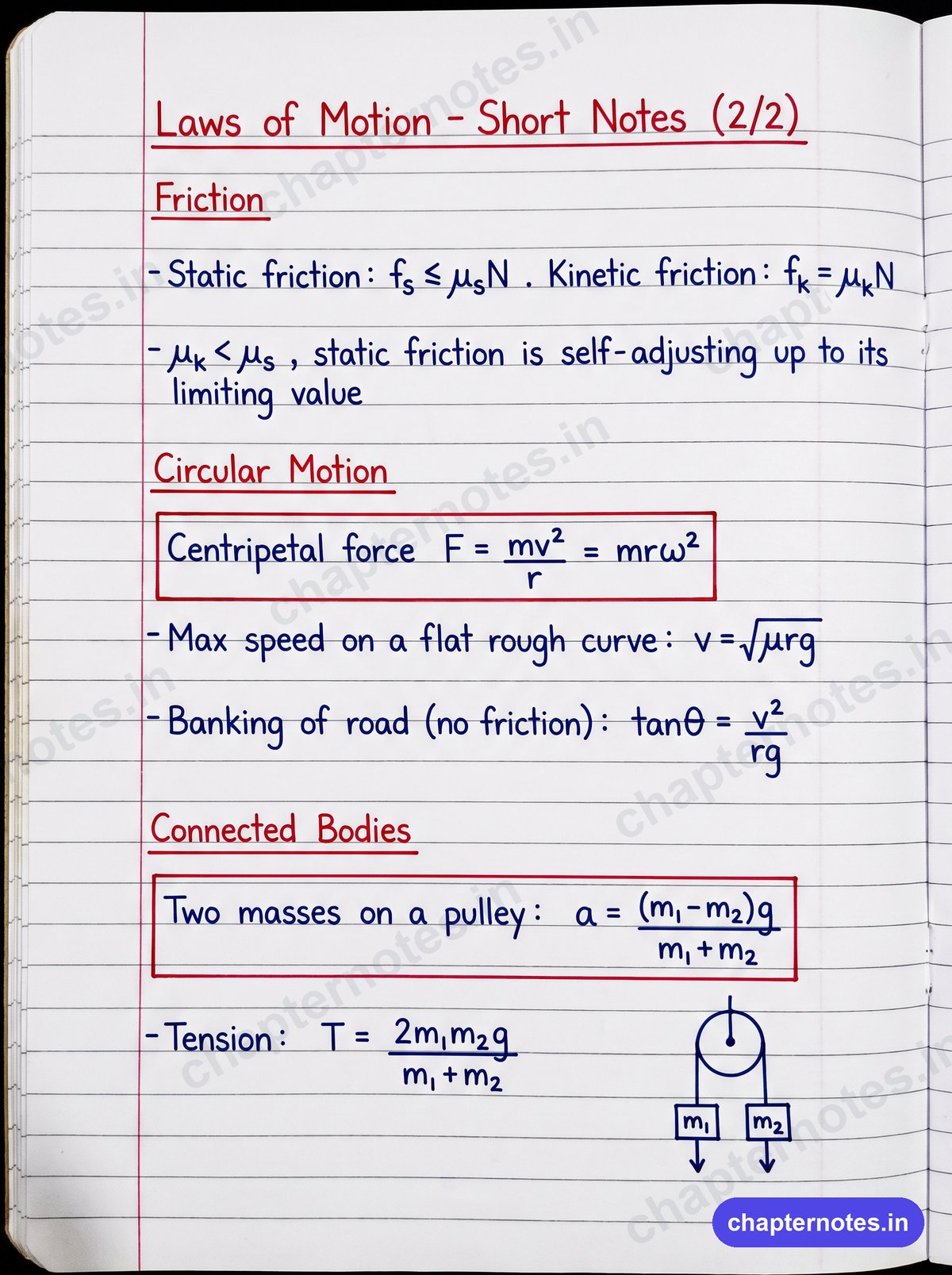
| Static friction (fₛ) | Acts when the body is at rest; self-adjusting up to a maximum | fₛ ≤ μₛN |
| Limiting friction (fₘₐₓ) | Maximum static friction, just before motion begins | fₘₐₓ = μₛN |
| Kinetic friction (f_k) | Acts when the body is in motion | f_k = μ_kN |
Note: μₛ > μ_k, which is why it is harder to start sliding an object than to keep it sliding.
Laws of Friction
- Friction is independent of the area of contact.
- Friction is proportional to the normal reaction N.
- Kinetic friction is nearly independent of speed.
Angle of Friction and Angle of Repose
- Angle of friction (φ): tan φ = μ — the angle between the resultant of N and limiting friction, and the normal.
- Angle of repose (θ): the minimum angle of an inclined plane at which a body just begins to slide. tan θ = μₛ. For a plane inclined at angle θ, the angle of repose equals the angle of friction.
11. Motion on an Inclined Plane
For a body of mass m on a frictionless incline of angle θ, gravity splits into two components.
- Along the incline (down): mg sin θ → causes acceleration a = g sin θ
- Perpendicular to incline: mg cos θ → balanced by normal reaction N = mg cos θ
With friction (body sliding down): a = g(sin θ − μ cos θ).
12. Dynamics of Circular Motion
When a body moves in a circle, its direction keeps changing, so it is accelerating even at constant speed. The acceleration points towards the centre — this is centripetal acceleration.
a_c = v²/r = ω²r
The net inward force causing this is the centripetal force:
F_c = mv²/r = mω²r
Important: Centripetal force is not a new kind of force — it is provided by tension, gravity, friction, or normal reaction depending on the situation.
Banking of Roads
On a curved road, banking (tilting the road inward) provides the centripetal force without relying entirely on friction.
- Ignoring friction: tan θ = v²/(rg), so the safe speed is v = √(rg tan θ).
- With friction (maximum speed): v_max = √[rg(tan θ + μ)/(1 − μ tan θ)]
Vehicle on a Level Curved Road
Here friction alone supplies the centripetal force, so the maximum safe speed is v_max = √(μrg).
Read the rest of the chapter →Hide the rest ↑
Weightage in Board & Entrance Exams
| Exam | Typical Weightage | Most-Tested Areas |
|---|---|---|
| CBSE Board (Class 11) | 8–10 marks | Newton’s laws, FBD, friction, conservation of momentum |
| JEE Main / Advanced | 2–4 questions (with Work-Energy) | Pulley-block systems, friction on inclines, circular motion |
| NEET | 2–3 questions | Momentum, impulse, friction, banking of roads |
[TABLE: Question-type split — VSA (1 mark): laws & definitions; SA (2–3 marks): FBD, friction numericals, impulse; LA (5 marks): conservation of momentum derivations, banking of roads.]
Important Definitions
| Term | Definition |
|---|---|
| Force | An external push or pull that changes a body’s state of rest or motion: F = ma |
| Inertia | Tendency of a body to resist change in its state of rest or uniform motion |
| Linear momentum | Quantity of motion: p = mv (a vector) |
| Newton’s second law | F = dp/dt = ma — force equals rate of change of momentum |
| Impulse | Product of force and time = change in momentum: J = FΔt = Δp |
| Conservation of momentum | Total momentum is constant if net external force is zero |
| Static friction | Self-adjusting opposing force on a body at rest: fₛ ≤ μₛN |
| Kinetic friction | Constant opposing force on a moving body: f_k = μ_kN |
| Angle of repose | Incline angle at which a body just begins to slide: tan θ = μₛ |
| Centripetal force | Inward force keeping a body in circular motion: F = mv²/r |
Solved Examples
Example 1
A force of 20 N acts on a body of mass 4 kg initially at rest. Find the acceleration and the velocity after 5 s.
Answer: a = F/m = 20/4 = 5 m/s². v = u + at = 0 + 5 × 5 = 25 m/s.
Example 2
A cricket ball of mass 0.15 kg moving at 20 m/s is stopped by a fielder in 0.1 s. Find the average force exerted.
Answer: Impulse = Δp = m(v − u) = 0.15(0 − 20) = −3 N·s. F = Δp/Δt = −3/0.1 = −30 N (magnitude 30 N, opposing motion).
Example 3
A gun of mass 5 kg fires a bullet of mass 25 g with a velocity of 500 m/s. Find the recoil velocity of the gun.
Answer: By conservation of momentum: 0 = MV + mv. V = −mv/M = −(0.025 × 500)/5 = −12.5/5 = −2.5 m/s (gun recoils at 2.5 m/s).
Example 4
A block of mass 10 kg rests on a horizontal surface with μₛ = 0.4. Find the minimum horizontal force needed to just move it. (g = 10 m/s²)
Answer: fₘₐₓ = μₛN = μₛmg = 0.4 × 10 × 10 = 40 N.
Example 5
A car of mass 1000 kg takes a circular turn of radius 50 m at 10 m/s. Find the centripetal force required.
Answer: F = mv²/r = (1000 × 10²)/50 = 100000/50 = 2000 N.
Example 6
Two masses m₁ = 5 kg and m₂ = 3 kg are connected by a string over a frictionless pulley (Atwood machine). Find the acceleration. (g = 10 m/s²)
Answer: a = (m₁ − m₂)g/(m₁ + m₂) = (5 − 3)(10)/(5 + 3) = 20/8 = 2.5 m/s². Tension T = 2m₁m₂g/(m₁ + m₂) = 2 × 5 × 3 × 10/8 = 37.5 N.
Important Questions for Board Exams
1-Mark Questions (VSA)
- Define one newton of force.
- Why does a passenger jerk forward when a moving bus stops suddenly?
- What is the SI unit of linear momentum?
- Why is it easier to pull a lawn roller than to push it?
- Can a body be in equilibrium under the action of a single force? Justify.
2–3-Mark Questions (SA)
- State and explain the impulse-momentum theorem with one real-life example.
- Define angle of repose and show that it equals the angle of friction (tan θ = μ).
- A body slides down a rough inclined plane of angle θ. Derive an expression for its acceleration.
- Explain why action and reaction, though equal and opposite, do not cancel each other.
5-Mark Questions (LA)
- State Newton’s second law and derive F = ma from it. Hence define one newton.
- State the law of conservation of linear momentum and derive it from Newton’s third law. Apply it to explain the recoil of a gun.
- Derive the expression for the maximum safe speed of a vehicle on a banked road with friction.
Quick Revision Points
- Inertia = resistance to change in motion; three types — rest, motion, direction
- First law (inertia): no net force needed for constant velocity
- Second law: F = dp/dt = ma; 1 N gives 1 kg an acceleration of 1 m/s²
- Momentum p = mv (vector); impulse J = FΔt = Δp
- Third law: action and reaction are equal, opposite, on different bodies
- Conservation of momentum holds when net external force = 0
- Friction: fₛ ≤ μₛN, f_k = μ_kN, with μₛ > μ_k
- Angle of repose: tan θ = μₛ; equals the angle of friction
- Incline (frictionless): a = g sin θ; with friction: a = g(sin θ − μ cos θ)
- Centripetal force F = mv²/r; banking (no friction): tan θ = v²/rg
- Level curve safe speed: v_max = √(μrg)
Next Chapter: Chapter 5 — Work, Energy and Power
Class 11 Physics · Chapter 5 – swipe through all 9 cards to understand the whole chapter.
Inertia & Newton’s First Law
A body keeps doing what it is already doing until a net external force changes it.
Holds only in an inertial (non-accelerating) frame.
- Inertia = resistance to a change in motion; more mass = more inertia.
- No force is needed to keep moving at constant velocity, only to change it.
- Three flavours: inertia of rest, of motion, of direction.
Newton’s Second Law
The net force on a body equals its mass times its acceleration.
Unit: newton (N) = kg·m·s⁻2; keep mass in kg.
- Always use the NET force — add/subtract opposing forces first.
- 10 N on 2 kg → a = F/m = 5 m·s⁻2.
- F and a are vectors and point the same way; velocity need not.
Momentum & the Deeper Law
Force is really the rate of change of momentum, the ‘quantity of motion’.
Collapses to F = ma when mass is constant.
- Momentum unit: kg·m·s⁻1.
- Use Δp/Δt for rockets, collisions and impulse problems.
- Longer contact time → smaller force (why you ‘give way’ on a catch).
Impulse–Momentum Theorem
A force acting over a time interval produces a change in momentum.
Unit of impulse: N·s = kg·m·s⁻1 (same as momentum).
- Same impulse, more time → less peak force (airbags, crumple zones).
- Catching a ball: pull hands back to lengthen Δt and cut the force.
- Impulse is a vector along the applied force.
Newton’s Third Law
Every action has an equal and opposite reaction, on a different body.
The pair acts on TWO different bodies, so it can never cancel.
- Swimmer pushes water back; water pushes swimmer forward.
- Trap: a book’s weight and the table’s normal force are NOT a pair (same body).
- Equal forces, unequal masses → unequal accelerations (gun recoil).
Conservation of Momentum
With no external force, the total momentum of a system stays constant.
Follows directly from F = Δp/Δt and the Third Law.
- Explains recoil: gun and bullet gain equal and opposite momentum.
- Rocket pushes gas down → rocket gains upward momentum.
- Holds in collisions and explosions, elastic or not.
Equilibrium of Forces
A body is in equilibrium when all the forces on it add to zero.
Zero net force ≠ at rest; it can move uniformly.
- Resolve forces into perpendicular components; each direction sums to zero.
- Balanced forces and ‘no force’ give identical motion.
- A body at constant velocity has zero acceleration, so zero net force.
Friction
A contact force that opposes the relative sliding of two surfaces.
μ is dimensionless; on flat ground N = mg.
- Static friction self-adjusts up to a ceiling f_max = μ_s·N.
- Kinetic friction is fixed at μ_k·N once sliding starts.
- Rolling friction ≪ sliding — why we use wheels and bearings.
Friction on an Incline
On a slope the weight splits into components and the normal force shrinks.
Body slips when mg·sinθ > μ_s·mg·cosθ, i.e. tanθ > μ_s.
- N is NOT mg on an incline; it is mg·cosθ, so friction drops too.
- Angle of repose: tanθ = μ_s, the steepest slope before sliding.
- Net force down the slope = mg·sinθ − f, then a = F_net/m.
📝 Practice Laws of Motion — 10 NEET PYQs
Real previous-year questions · with answers & solutions
Start →Close ✕
Chapter Navigation
Previous: Motion in a Plane Class 11 Notes
Next: Work, Energy and Power Class 11 Notes
Related Chapters in Class 11 Physics
- Work, Energy and Power Class 11 Notes
- Systems of Particles and Rotational Motion Class 11 Notes
- Gravitation Class 11 Notes
Practice What You Learned
Take your mechanics further with our Class 12 Physics notes once you are board-ready.
Explore More
Frequently Asked Questions
Newton’s first law states that a body stays at rest, or keeps moving in a straight line at constant speed, unless a net external force acts on it. This tendency to resist any change in its state of motion is called inertia, and a body with more mass has more inertia.
Newton’s second law is F_net = m times a, meaning the net force on a body equals its mass times its acceleration. More generally force is the rate of change of momentum, F = dp/dt, and the unit of force is the newton (N), equal to kg times m per second squared.
Yes, Laws of Motion is part of the NEET physics syllabus and is a high-yield mechanics chapter. It is tested directly and its force-balance and free-body-diagram skills carry over into work-energy, circular motion, and many other numerical problems, so it gives strong returns for the effort.
Static friction acts before sliding begins and self-adjusts up to a maximum of mu_s times N, balancing the applied force until that limit. Kinetic friction acts while the surfaces are sliding and stays fixed at mu_k times N opposite to the motion, and since mu_s is greater than mu_k it takes more force to start sliding than to keep it going.
A Newton’s third law action-reaction pair must act on two different bodies, but the book’s weight and the table’s normal force both act on the book itself, so they are not a pair. The true reaction to Earth pulling the book down is the book pulling Earth up.
