
Electric Charges and Fields is Chapter 1 of CBSE Class 12 Physics. This chapter introduces electrostatics - the study of forces, fields, and potentials arising from static charges. You will learn about Coulomb’s law, electric field, electric field lines, electric flux, and Gauss’s law.
Think of scuffing your feet on a carpet and then getting a tiny shock off a doorknob. That spark is electrostatics in action. In this chapter you will learn exactly why that happens, how to put a number on the force between charges, how to picture the invisible field around them, and how one elegant idea, Gauss’s law, lets you crack fields that would otherwise need heavy calculus. Work through the derivations and diagrams below and you will be able to answer any board question on Electric Charges and Fields with confidence.
- Electric Charge and its properties
- Coulomb’s Law (with vector-form derivation)
- Electric Field and field due to a point charge
- Electric Field Lines (diagrams)
- Electric Dipole: axial, equatorial and torque derivations
- Electric Flux and Gauss’s Law (three applications derived)
- Important Definitions
- Solved Examples, Important Questions and Quick Revision
Exam Weightage: how much does this chapter matter?
Electric Charges and Fields sits inside Unit I (Electrostatics) of the CBSE Class 12 Physics syllabus. Electrostatics as a whole carries a healthy chunk of the 70-mark theory paper, and this chapter is the foundation that Chapter 2 (Potential and Capacitance) builds on. Use the split below to decide where to spend your revision time.
| Question type | Typical marks | What gets asked |
|---|---|---|
| VSA / MCQ (1 mark) | 1 to 2 | Quantisation, SI units, field-line rules, flux facts |
| Short Answer (2 to 3 marks) | 3 to 4 | Coulomb’s law, torque on a dipole, flux calculations |
| Long Answer (5 marks) | 5 | Gauss’s law applied to a sheet, wire or shell with full derivation |
| Unit total (Electrostatics) | ~16 | Chapters 1 and 2 combined across the paper |
High-yield tip: the 5-mark derivations from Gauss’s law are asked almost every year. Learn all three (line, sheet, shell) cold.
Key Concepts
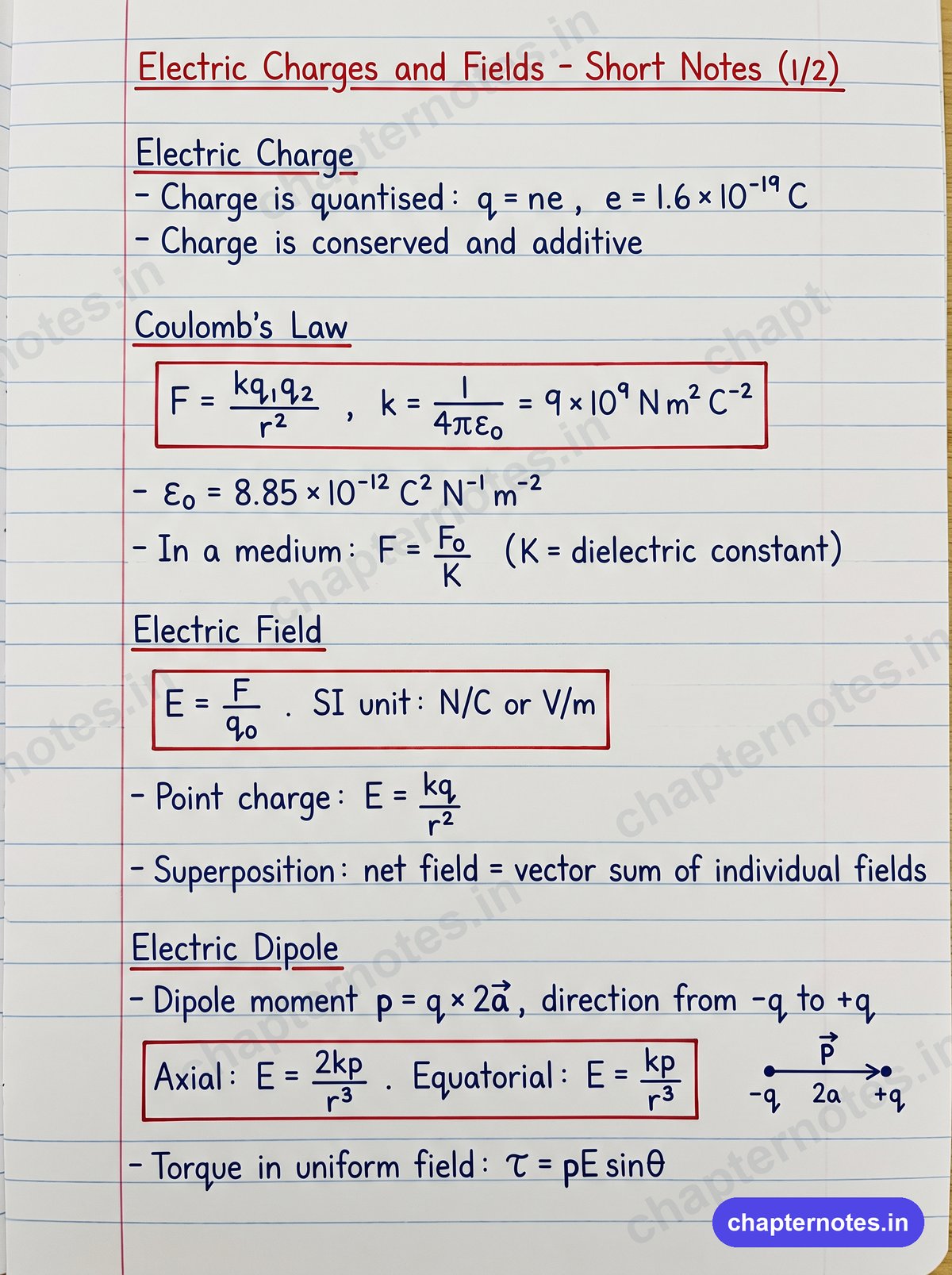
1. Electric Charge
Electric charge is a fundamental property of matter that makes it experience a force in an electric field. Rub a glass rod with silk and it can attract tiny bits of paper: that attraction is the charge you just created by transferring electrons. There are two kinds:
- Positive charge: what a proton carries.
- Negative charge: what an electron carries.
Like charges repel and unlike charges attract. The SI unit of charge is the coulomb (C). The charge on a single electron is e = 1.6 × 10⁻¹⁹ C.
Three properties you must state correctly
- Quantisation: charge always comes in whole-number multiples of e. Any charge q = ne, where n is an integer (positive or negative). You can never have half an electron’s worth of charge.
- Conservation: the total charge of an isolated system stays constant. Charge is never created or destroyed, only transferred from one body to another. When you charge a rod by friction, the silk gains exactly the charge the rod loses.
- Additivity: the total charge of a body is the algebraic sum (with signs) of all the charges on it. A body with +5 C and −3 C carries a net +2 C.
Methods of charging
| Method | What happens |
|---|---|
| Friction | Rubbing two different materials transfers electrons from one to the other, leaving one positive and one negative. |
| Conduction | Touching a charged body to an uncharged conductor shares the charge between them. |
| Induction | Bringing a charged body near (without touching) an uncharged conductor pulls its charges apart, so the near face gets an opposite charge. No net charge is transferred. |
2. Coulomb’s Law
Coulomb measured how two point charges push or pull on each other. His result: the force between two point charges is directly proportional to the product of their magnitudes and inversely proportional to the square of the distance between them.
F = k q₁q₂ / r²
- k = 1/(4πε₀) = 9 × 10⁹ N·m²/C² (Coulomb’s constant in vacuum)
- ε₀ = 8.854 × 10⁻¹² C²/(N·m²), the permittivity of free space
- Like charges repel, unlike charges attract, and the force acts along the line joining the two charges.
Inside a medium: F = k q₁q₂ / (κ r²), where κ (kappa) is the dielectric constant of the medium. Since κ is greater than 1, the force is always weaker in a medium than in vacuum.
Deriving the vector form (step by step)
Marks are often lost because students give only the magnitude. The vector form carries the direction automatically. Let charge q₁ sit at position r₁ and q₂ at position r₂.
Step 1. The vector pointing from q₂ to q₁ is r₁₂ = r₁ − r₂, and its length is the separation r = |r₁₂|.
Step 2. The unit vector along that direction is r̂₁₂ = r₁₂ / r.
Step 3. The force on q₁ due to q₂ points along this unit vector when the charges are alike (repulsion) and opposite to it when they are unlike (attraction). Both cases are captured in one line by keeping the signs of the charges:
F₁₂ = (1/4πε₀) · (q₁q₂ / r²) r̂₁₂
Step 4 (check the signs). If q₁q₂ is positive (like charges), F₁₂ points along r̂₁₂, that is away from q₂: repulsion. If q₁q₂ is negative (unlike charges), the force reverses: attraction. By Newton’s third law, F₂₁ = −F₁₂.
Superposition principle
When more than two charges are present, deal with them in pairs. The net force on any one charge is the vector sum of the separate forces from every other charge, each calculated by Coulomb’s law as if the others were absent:
F₁ = F₁₂ + F₁₃ + F₁₄ + …
This is why a charge sitting exactly between two equal like charges feels zero net force: the two pulls are equal and opposite.
3. Electric Field
Rather than talk about action at a distance, physics uses a field. The electric field at a point is the force experienced by a small unit positive test charge placed there.
E = F / q₀ = k Q / r²
The second form is the field a distance r away from a single point charge Q. The unit of electric field is N/C, which is the same as V/m. Electric field is a vector: it points away from a positive charge and towards a negative charge. We keep the test charge q₀ vanishingly small so it does not disturb the charge whose field we are measuring.
Electric field due to common configurations
| Configuration | Electric field |
|---|---|
| Point charge Q | E = kQ/r² |
| Dipole, axial point (far away) | E = 2kp/r³ |
| Dipole, equatorial point (far away) | E = kp/r³ |
| Infinite line charge (linear density λ) | E = λ/(2πε₀r) |
| Infinite plane sheet (surface density σ) | E = σ/(2ε₀) |
| Two parallel sheets (+σ and −σ) | E = σ/ε₀ between them, 0 outside |
4. Electric Field Lines
Field lines are imaginary curves drawn so that the tangent at any point gives the direction of the field there, and the crowding of the lines shows its strength. They turn an invisible vector field into a picture you can read at a glance.
Field lines of an isolated positive charge point outward; those of a negative charge point inward. The lines get farther apart as you move away, showing the field weakening as 1/r².
Two like charges: the lines push apart and no line runs between them (there is a neutral point in the middle). Two unlike charges: lines leave the positive charge and dive straight into the negative charge, which is why they attract.
Properties (state these exactly in exams)
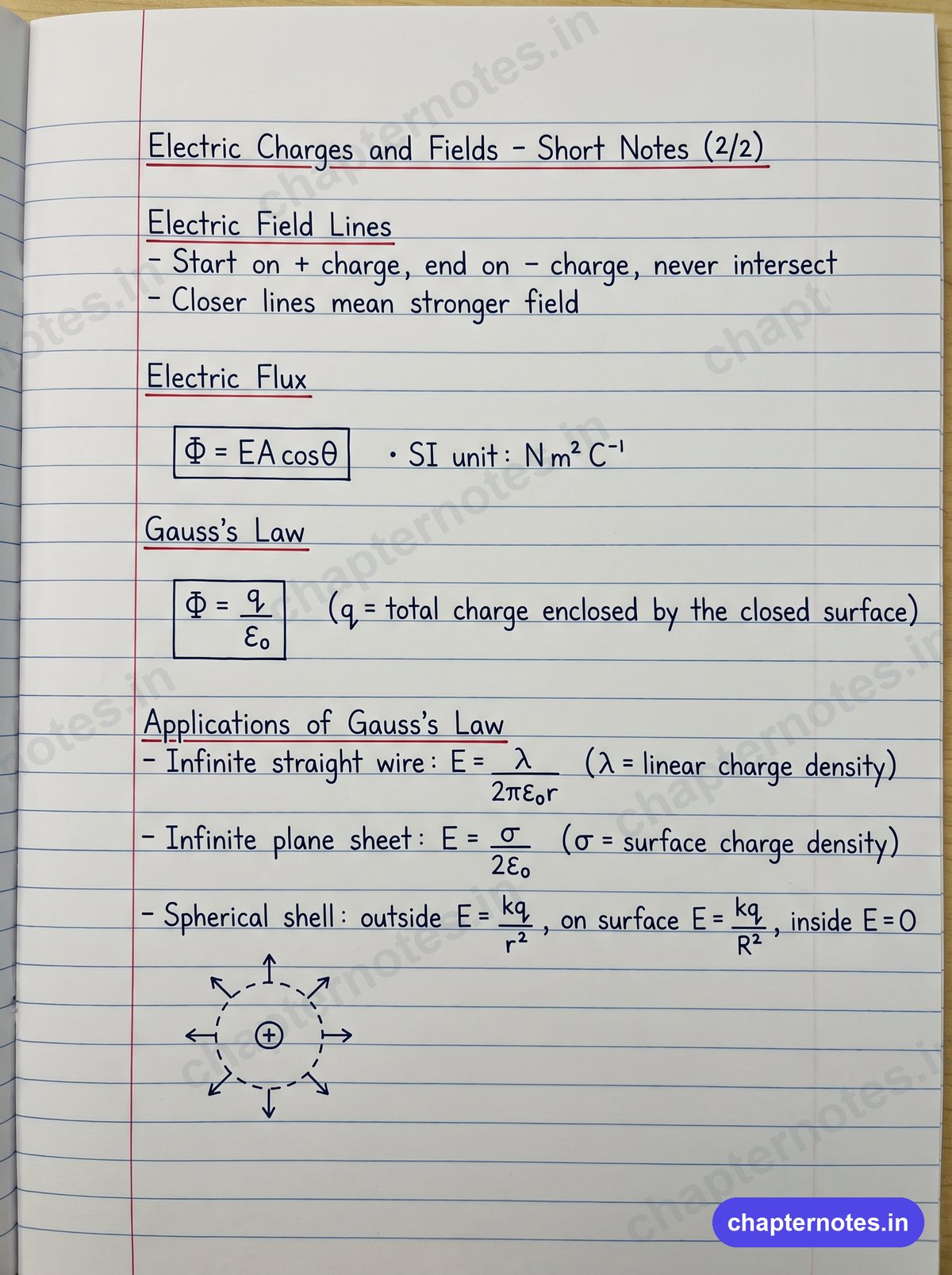
- Field lines start on positive charges and end on negative charges.
- Two field lines never cross. If they did, the field would have two directions at one point, which is impossible.
- Where lines are closer together the field is stronger.
- They meet the surface of a conductor at right angles.
- They do not form closed loops (unlike magnetic field lines) and have no breaks in a charge-free region.
5. Electric Dipole
An electric dipole is a pair of equal and opposite charges, +q and −q, held a small distance 2a apart. Molecules like HCl and water behave as tiny dipoles, which is what makes water such a good solvent.
An electric dipole: charges +q and −q separated by 2a. The dipole moment p points from the negative to the positive charge and has magnitude q(2a).
The dipole moment measures how strong the dipole is and which way it faces:
p = q × 2a
It is a vector of unit C·m that points from the negative charge to the positive charge.
The field of a dipole: lines leave +q, curve through space, and return to −q. Close to the dipole the pattern is complex; far away it falls off as 1/r³, faster than a single charge.
Field on the axial line (derivation)
Take a point P on the axis of the dipole, a distance r from its centre. The +q is nearer (distance r − a) and the −q is farther (distance r + a).
Step 1. Field due to +q, pointing away from it (along p): E+ = kq/(r − a)².
Step 2. Field due to −q, pointing towards it (opposite to p): E− = kq/(r + a)².
Step 3. The net axial field is their difference (they point opposite ways):
E = kq [ 1/(r − a)² − 1/(r + a)² ]
Step 4. Put over a common denominator: (r + a)² − (r − a)² = 4ar, so
E = kq · 4ar / (r² − a²)²
Step 5. Since p = 2aq, substitute 2aq for p:
Eaxial = (1/4πε₀) · 2pr / (r² − a²)²
Step 6 (short dipole). For a point far away, r is much greater than a, so a² is negligible next to r²:
Eaxial = 2kp / r³, directed along p.
Field on the equatorial line (derivation)
Now take a point P on the perpendicular bisector, a distance r from the centre. Each charge is the same distance √(r² + a²) from P, so the two fields have equal magnitude kq/(r² + a²).
Step 1. Resolve each field into a component along the axis and one perpendicular to it. By symmetry the perpendicular components are equal and opposite, so they cancel.
Step 2. The components along the axis (pointing from +q towards −q, that is opposite to p) add up. Each contributes a factor cosθ, where cosθ = a/√(r² + a²):
E = 2 · [ kq/(r² + a²) ] · a/√(r² + a²) = 2kqa / (r² + a²)3/2
Step 3. Again p = 2aq, so
Eequat = kp / (r² + a²)3/2, directed opposite to p.
Step 4 (short dipole). For r much greater than a: Eequat = kp/r³. Notice the axial field is exactly twice the equatorial field at the same distance.
Torque on a dipole in a uniform field (derivation)
Place the dipole in a uniform field E at an angle θ to the field. The +q feels a force qE one way and the −q feels qE the opposite way.
Step 1. The two forces are equal, opposite and not along the same line, so they form a couple. The net force is zero, which means the dipole does not move off, it only turns.
Step 2. The torque of a couple is force times the perpendicular distance between the two forces. That perpendicular distance is 2a sinθ:
τ = qE × (2a sinθ) = (q · 2a) E sinθ
Step 3. Since p = q · 2a,
τ = pE sinθ, or in vector form τ = p × E
The torque is maximum (pE) when θ = 90° and zero when θ = 0° or 180°. The dipole turns until it lines up with the field.
6. Electric Flux and Gauss’s Law
Electric flux through a surface tells you how many field lines pierce it. If the field E crosses an area A whose normal makes an angle θ with the field, then
Φ = E · A = EA cosθ
Its unit is N·m²/C (the same as V·m). Flux is largest when the surface faces the field square on (θ = 0) and zero when the surface lies along the field (θ = 90°).
Electric flux depends on the angle θ between the field E and the surface normal A. Only the part of E along the normal pushes lines through the surface, giving the cosθ factor.
Gauss’s Law
Gauss’s law is the shortcut that makes hard field problems easy whenever there is symmetry. It states that the total electric flux through any closed surface equals 1/ε₀ times the net charge enclosed by that surface:
∮ E · dA = qenclosed / ε₀
The clever part: charges outside the surface contribute zero net flux, and the shape of the surface does not matter, only the charge inside. Pick a closed surface (a Gaussian surface) that matches the symmetry of the problem so that E is constant and either parallel or perpendicular to it everywhere. Here are the three classic applications, each derived in full.
(a) Field due to an infinite line charge
Gaussian surface for a line charge: a coaxial cylinder of radius r and length l. By symmetry E is radial and constant on the curved surface, and zero flux passes through the flat end caps.
Step 1. A wire with linear charge density λ has cylindrical symmetry, so choose a coaxial cylinder of radius r and length l as the Gaussian surface.
Step 2. E is radial, so it is parallel to the flat end caps (no flux through them) and perpendicular to the curved surface. Flux = E × (curved area) = E · 2πrl.
Step 3. Charge enclosed by length l of wire = λl. Apply Gauss’s law:
E · 2πrl = λl / ε₀
Step 4. Cancel l and solve:
E = λ / (2πε₀r)
The field of a line charge falls off as 1/r, more slowly than a point charge.
(b) Field due to an infinite plane sheet
Gaussian surface for a charged sheet: a pill-box that pokes through the sheet. The field leaves both flat faces equally, so the flux is 2EA; no flux passes through the curved side.
Step 1. A sheet with surface charge density σ has planar symmetry. The field points straight out from both faces. Choose a pill-box (a small cylinder) that pierces the sheet, with each flat face of area A.
Step 2. E is perpendicular to both flat faces and parallel to the curved side (no flux there). Flux through the two faces = EA + EA = 2EA.
Step 3. Charge enclosed = σA. Apply Gauss’s law:
2EA = σA / ε₀
Step 4. Cancel A and solve:
E = σ / (2ε₀)
Remarkably, this does not depend on distance: the field of an infinite sheet is uniform on each side.
(c) Field due to a uniformly charged thin spherical shell
Gaussian surface for a spherical charge: a concentric sphere of radius r. By symmetry E is radial and constant everywhere on it, so flux = E × 4πr².
Step 1. A shell of radius R carrying charge Q has spherical symmetry. Choose a concentric sphere of radius r as the Gaussian surface. E is radial and constant on it, so flux = E · 4πr².
Step 2 (outside, r > R). The whole charge Q is enclosed:
E · 4πr² = Q / ε₀ ⇒ E = kQ/r²
So from outside, the shell behaves as if all its charge sat at the centre.
Step 3 (on the surface, r = R). E = kQ/R².
Step 4 (inside, r < R). No charge is enclosed by the inner sphere, so:
E · 4πr² = 0 / ε₀ ⇒ E = 0
The field is zero everywhere inside a hollow charged shell or conductor. (For a uniformly charged solid sphere the inside field instead grows linearly, E = kQr/R³.)
7. Continuous Charge Distributions
Real charged objects are not single points; the charge is spread out. We describe that spread with a charge density and add up (integrate) the contributions of every tiny element dq.
- Linear charge density λ = charge per unit length (C/m). A charged wire uses dq = λ dl.
- Surface charge density σ = charge per unit area (C/m²). A charged sheet or plate uses dq = σ dA.
- Volume charge density ρ = charge per unit volume (C/m³). A charged solid uses dq = ρ dV.
The field of the whole body is the vector sum of the fields of all its elements:
E = (1/4πε₀) ∫ (dq / r²) r̂
Doing that integral directly is hard, which is exactly why Gauss’s law is such a gift whenever the distribution is symmetric.
8. Conductors in an Electrostatic Field
Metals are full of free electrons, and that gives a charged conductor at rest four properties you should be ready to prove or state.
- The field inside a conductor is zero. If any field remained, the free electrons would keep moving; they only stop once the internal field is cancelled everywhere.
- Any excess charge sits on the outer surface. Put a Gaussian surface just inside the metal: the field there is zero, so the enclosed charge must be zero, which forces all the charge to the surface.
- The field just outside is perpendicular to the surface and has magnitude σ/ε₀.
- The whole conductor is at one potential (you will use this in Chapter 2).
Field just outside a charged conductor (derivation)
Step 1. Take a small pill-box Gaussian surface with one flat face just outside the conductor and the other just inside, each of area A.
Step 2. Inside the conductor E = 0, so that face passes no flux. Outside, E is perpendicular to the surface, so only the outer face carries flux = EA.
Step 3. Charge enclosed = σA. Apply Gauss’s law: EA = σA/ε₀.
E = σ / ε₀
Note this is twice the field of an isolated sheet, because for a conductor all the field is pushed out to one side.
9. Two Useful Comparisons and an Application
Electrostatic shielding. Because the field inside a conductor is zero, the space inside a hollow conductor is completely protected from any outside electric field. This is called electrostatic shielding, and it is why you are safe inside a car during a lightning strike and why sensitive electronics sit inside metal cans. The hollow conductor acts as a Faraday cage.
Coulomb’s force compared with gravity. The two forces look alike on paper, but their strengths and behaviour differ sharply. Knowing the contrast is a common 1-mark or 2-mark question.
| Feature | Coulomb (electrostatic) | Gravitational |
|---|---|---|
| Formula | F = kq₁q₂/r² | F = Gm₁m₂/r² |
| Nature | Attractive or repulsive | Always attractive |
| Depends on medium? | Yes (falls in a dielectric) | No |
| Relative strength | Far stronger (about 10³⁶ times) | Extremely weak |
Both obey the inverse-square law and both act along the line joining the two bodies, which is why the mathematics of the two chapters rhymes so closely.
Important Definitions
| Term | Definition |
|---|---|
| Electric charge | A fundamental property of matter that makes it experience an electromagnetic force. |
| Quantisation of charge | Charge exists only as whole-number multiples of e: q = ne. |
| Coulomb’s law | F = kq₁q₂/r², the force between two point charges. |
| Electric field | Force per unit positive test charge at a point: E = F/q₀. |
| Electric field line | A curve whose tangent gives the field direction and whose crowding shows field strength. |
| Electric dipole | Two equal and opposite charges separated by a small distance 2a. |
| Dipole moment | p = q × 2a, pointing from −q to +q; measures dipole strength. |
| Electric flux | Number of field lines through a surface: Φ = EA cosθ. |
| Gauss’s law | Total flux through a closed surface = qenclosed/ε₀. |
| Dielectric constant | The factor by which a medium reduces the electric force compared with vacuum. |
Read the rest of the chapter →Hide the rest ↑
Solved Examples
Example 1: Force between two charges
Two charges of +3 μC and −3 μC are placed 20 cm apart. Find the force between them.
Solution. Use F = kq₁q₂/r² with r = 0.2 m:
F = (9 × 10⁹)(3 × 10⁻⁶)(3 × 10⁻⁶) / (0.2)² = (9 × 10⁹)(9 × 10⁻¹²) / 0.04 = (81 × 10⁻³) / 0.04 = 2.025 N. The charges are unlike, so the force is attractive.
Example 2: Torque on a dipole
A dipole of moment 4 × 10⁻⁹ C·m sits in a uniform field of 5 × 10⁴ N/C at 30° to the field. Find the torque.
Solution. τ = pE sinθ = (4 × 10⁻⁹)(5 × 10⁴) sin 30° = (20 × 10⁻⁵)(0.5) = 1 × 10⁻⁴ N·m.
Example 3: Flux through a sphere
A sphere of radius 10 cm encloses a charge of 5 μC. Find the electric flux through it.
Solution. By Gauss’s law Φ = q/ε₀ = (5 × 10⁻⁶)/(8.854 × 10⁻¹²) = 5.65 × 10⁵ N·m²/C. The flux depends only on the enclosed charge, not on the radius of the sphere.
Example 4: Field of a line charge
Find the field 20 cm from an infinitely long wire of linear charge density 5 × 10⁻⁶ C/m.
Solution. E = λ/(2πε₀r) = (5 × 10⁻⁶) / (2π × 8.854 × 10⁻¹² × 0.2) = (5 × 10⁻⁶)/(1.113 × 10⁻¹¹) = 4.49 × 10⁵ N/C, directed radially away from the wire.
Example 5: Superposition of forces
Charges of +2 μC and +2 μC are fixed 10 cm apart. What force acts on a +1 μC charge placed exactly midway between them?
Solution. Each charge is 5 cm (0.05 m) from the middle. Each force = (9 × 10⁹)(2 × 10⁻⁶)(1 × 10⁻⁶)/(0.05)² = 7.2 N, but they point in opposite directions. Net force = 7.2 − 7.2 = 0 N. The midpoint is an equilibrium position.
Example 6: Field of a charged shell
A hollow metal sphere of radius 8 cm carries a charge of 4 μC. Find the field (a) at 20 cm from the centre and (b) at 4 cm from the centre.
Solution. (a) Outside (r = 0.2 m > R): E = kQ/r² = (9 × 10⁹)(4 × 10⁻⁶)/(0.2)² = 9 × 10⁵ N/C. (b) Inside the shell (r = 0.04 m < R): the enclosed charge is zero, so E = 0.
Example 7: Number of electrons
How many electrons make up a charge of −2 μC?
Solution. By quantisation q = ne, so n = q/e = (2 × 10⁻⁶)/(1.6 × 10⁻¹⁹) = 1.25 × 10¹³ electrons. The charge is negative, so these are extra electrons the body has gained.
Example 8: Field of an infinite sheet
A large plane sheet carries a surface charge density of 2 × 10⁻⁶ C/m². Find the field close to the sheet.
Solution. E = σ/(2ε₀) = (2 × 10⁻⁶)/(2 × 8.854 × 10⁻¹²) = 1.13 × 10⁵ N/C. The answer does not depend on how far you stand from the sheet, because the field of an infinite sheet is uniform.
Common Mistakes to Avoid
- Forgetting the direction. Coulomb’s law and the field are vectors; a board answer without direction loses marks. State attraction or repulsion, or the unit vector.
- Adding forces or fields like plain numbers. Superposition is a vector sum, so resolve into components when the charges are not in a line.
- Mixing up axial and equatorial dipole fields. Axial is 2kp/r³ and points along p; equatorial is kp/r³ and points opposite to p. The axial field is twice the equatorial one.
- Writing the sheet field with a distance in it. E = σ/(2ε₀) is uniform and independent of distance. Do not divide by r.
- Saying the flux depends on the size of the Gaussian surface. It depends only on the enclosed charge.
- Claiming the field inside a solid charged sphere is zero. It is zero only inside a hollow shell or a conductor. Inside a uniformly charged solid sphere the field grows as kQr/R³.
Important Questions for Board Exams
Very Short Answer (1 mark)
- State Coulomb’s law in electrostatics.
- What is the SI unit of electric flux?
- Why can two electric field lines never cross each other?
- What is the electric field inside a charged hollow conductor?
- Define the dielectric constant of a medium.
- Give the direction of the dipole moment vector.
Short Answer (2 to 3 marks)
- Derive the expression for the electric field at a point on the axial line of a short electric dipole.
- State Gauss’s law and use it to find the field due to an infinitely long straight charged wire.
- Define electric dipole moment and derive the torque on a dipole placed in a uniform electric field.
- Two point charges of 2 μC and −2 μC are 6 cm apart. Find the dipole moment and the torque when the dipole is at 30° to a field of 10⁴ N/C.
- Show that the electric field just outside a charged conductor is σ/ε₀.
Long Answer (5 marks)
- State Gauss’s law. Apply it to derive the field due to (a) a uniformly charged infinite plane sheet and (b) a uniformly charged thin spherical shell (outside, on the surface and inside).
- Derive the expression for the field on the equatorial line of an electric dipole, and compare it with the axial field at the same distance.
- Using Gauss’s law, obtain Coulomb’s law for the force between two point charges.
Quick Revision Points
- Charge is quantised (q = ne), conserved and additive.
- Coulomb’s law: F = kq₁q₂/r², with k = 9 × 10⁹ N·m²/C².
- Vector form carries direction: F₁₂ = k(q₁q₂/r²) r̂₁₂.
- Superposition: the net force or field is the vector sum of the individual ones.
- Field of a point charge: E = kQ/r², away from +, towards −.
- Dipole moment p = q × 2a, from −q to +q.
- Axial field 2kp/r³ (along p); equatorial field kp/r³ (opposite p); axial is twice equatorial.
- Torque on a dipole: τ = pE sinθ = p × E; net force in a uniform field is zero.
- Flux: Φ = EA cosθ; Gauss’s law: Φ = qenclosed/ε₀.
- Line charge: E = λ/(2πε₀r). Sheet: E = σ/(2ε₀), uniform. Shell: E = kQ/r² outside, 0 inside.
Next Chapter: Chapter 2, Electrostatic Potential and Capacitance. See also our Class 12 Physics notes hub for every chapter.
Derivation diagrams
Every derivation this chapter can ask you to reproduce, drawn once and then worked through. In each one the figure is doing the real work: pick the wrong surface or the wrong resolution and no amount of algebra saves the answer.
1. Field of a dipole on the axial line
Scroll the figure sideways to see all of it.
- Put P on the dipole axis, a distance r from the centre O. It is r − a from +q and r + a from −q.
- Both contributions lie along the axis, so this is scalar addition with a sign, not a vector triangle.
- E₊ = kq/(r − a)² pointing away from +q, E₋ = kq/(r + a)² pointing back towards −q.
- Subtract, then put the two fractions over a common denominator: E = kq[(r + a)² − (r − a)²] / (r² − a²)² = 4kqar / (r² − a²)².
- Write it with the dipole moment p = q(2a): E = 2kpr / (r² − a²)².
For a short dipole (r ≫ a): E = 2kp / r³, directed along p.
2. Field of a dipole on the equatorial line
Scroll the figure sideways to see all of it.
- Now put P on the perpendicular bisector, r from the centre. Both charges are the same distance √(r² + a²) away.
- So E₊ and E₋ are equal in magnitude, k q/(r² + a²), but point along different lines. This one needs resolution into components.
- Resolve each along the bisector and parallel to the axis. The components along the bisector are equal and opposite, so they cancel.
- The two components parallel to the axis both point from +q towards −q and add: E = 2 × kq/(r² + a²) × cos θ, where cos θ = a/√(r² + a²).
- That gives E = k q(2a) / (r² + a²)^(3/2) = kp / (r² + a²)^(3/2).
For a short dipole: E = kp / r³, which is half the axial value and points opposite to p.
3. Torque on a dipole in a uniform field
Scroll the figure sideways to see all of it.
- In a uniform field the two charges feel forces of the same size qE in opposite directions, so the net force is zero. The dipole does not drift, it turns.
- Equal, opposite, non-collinear forces form a couple, and the torque of a couple is force × perpendicular distance between the lines of action.
- From the figure that perpendicular distance is 2a sin θ.
- So τ = qE × 2a sin θ = (q · 2a) E sin θ = pE sin θ.
τ = pE sin θ, or in vector form τ = p × E. It is zero at θ = 0° (stable) and θ = 180° (unstable), and largest at 90°.
4. Field of an infinite line charge (Gauss's law)
Scroll the figure sideways to see all of it.
- By symmetry the field must point straight out from the wire and depend only on the distance r. Choose a Gaussian surface that respects that: a coaxial cylinder of radius r and length l.
- The two flat ends are parallel to E, so E · dA = 0 there. They contribute nothing, which is the whole reason this surface was chosen.
- On the curved surface E is perpendicular to it and has the same magnitude everywhere, so the flux is just E × (curved area) = E(2πrl).
- Charge enclosed is λl, so Gauss’s law gives E(2πrl) = λl/ε₀.
E = λ / (2πε₀r). Note it falls off as 1/r, not 1/r².
5. Field of an infinite plane sheet (Gauss's law)
Scroll the figure sideways to see all of it.
- By symmetry E points straight out of the sheet on both sides and cannot depend on how far along the sheet you are.
- Take a pillbox: a short cylinder pushed through the sheet so one flat cap of area A sits on each side.
- The curved side runs parallel to E, so no flux passes through it. Each cap contributes EA, giving a total flux of 2EA.
- Charge enclosed is σA, so 2EA = σA/ε₀.
E = σ / (2ε₀). It does not depend on distance at all, which is the classic result students misremember as 1/r².
6. Field of a uniformly charged spherical shell (Gauss's law)
Scroll the figure sideways to see all of it.
- Symmetry again fixes the surface: concentric spheres, because E must be radial and depend only on r.
- For r < R, the Gaussian sphere lies inside the shell and encloses no charge at all. So E(4πr²) = 0.
- For r > R, it encloses the whole charge Q, so E(4πr²) = Q/ε₀.
- At r = R exactly, the two expressions disagree, which is why the field is discontinuous across a charged surface.
Inside: E = 0. Outside: E = kQ/r², identical to a point charge Q at the centre.
Class 12 Physics · Chapter 1 – swipe through all 8 cards to understand the whole chapter.
Electric Charge
A fundamental property of matter; comes in positive and negative.
Quantised · additive · conserved
- Like charges repel
- Unlike charges attract
- Unit: coulomb (C)
Coulomb’s Law
Force between two point charges at rest.
k = 9×10⁹ N·m2/C2
- Inverse-square law
- Acts along the line joining them
- Weaker in a medium (÷κ)
Electric Field
Force per unit positive test charge at a point.
Unit: N/C or V/m · vector
- Points away from +Q
- Points toward −Q
- Superpose fields as vectors
Electric Field Lines
Imaginary lines mapping the direction of the field.
Start on +, end on −
- Never cross each other
- Tangent gives E direction
- Closer lines mean stronger field
Electric Dipole
A pair of equal and opposite charges separated by 2a.
p is a vector (C·m), from − to +
- Axial field is double the equatorial
- Field falls as 1/r3
- Dipole moment p = q × 2a
Torque on a Dipole
A uniform field turns a dipole but exerts no net force.
Net force = 0 in a uniform field
- Stable equilibrium at θ = 0°
- Unstable at θ = 180°
- Potential energy U = −pE cosθ
Electric Flux
Measure of the field lines passing through a surface.
Scalar · unit N·m2/C
- Maximum when E is perpendicular to surface
- Zero when E is parallel to surface
- Sign depends on direction
Gauss’s Law
Total flux through a closed surface depends only on the enclosed charge.
Use symmetry to find E
- Sheet: E = σ/2ε0
- Line: E = λ/2πε0r
- Inside a conductor E = 0
📝 Practice Electric Charges and Fields — 10 NEET PYQs
Real previous-year questions · with answers & solutions
Start →Close ✕
Chapter Navigation
Previous: This is the first chapter
Next: Electrostatic Potential and Capacitance Class 12 Notes
Related Chapters in Class 12 Physics
- Electrostatic Potential and Capacitance Class 12 Notes
- Current Electricity Class 12 Notes
- Moving Charges and Magnetism Class 12 Notes
Practice What You Learned
Test yourself with our JEE Main Mock Test Set 1 to see how well you’ve mastered the concepts.
Explore More
Frequently Asked Questions
An electric field is the force experienced per unit positive test charge at a point, E = F/q0, measured in N/C or V/m. The force is what one charge actually feels, while the field is a property of the region created by other charges that exists whether or not a test charge is placed there.
Coulomb’s law gives the electrostatic force between two point charges as F = k q1 q2 / r squared, where k = 1/(4 pi epsilon-naught) is about 9 times 10 to the power 9 N m squared per C squared. The force acts along the line joining the charges and follows the inverse-square law.
Yes, it is part of the NEET syllabus and is a high-yield electrostatics chapter, typically contributing one to two questions and forming the base for Electrostatic Potential, Capacitance and Current Electricity. Gauss’s law, the dipole and Coulomb’s law are the most frequently tested ideas.
Electric field is a vector that describes the force per unit charge at a point, while electric flux is a scalar that measures how many field lines pass through a given surface, Phi = E A cos theta. Flux depends on both the field strength and the orientation of the surface relative to the field.
Gauss’s law states that the total electric flux through any closed surface equals the charge enclosed divided by epsilon-naught, Phi = q-enclosed / epsilon-naught. It is useful because, for symmetric charge distributions like a sheet, line or sphere, it lets you find the electric field quickly without integrating Coulomb’s law.
Student doubts, answered
Real questions readers sent us from this page. If something here is still unclear, use the ask button in the corner and the answer gets added below.
Can you add the diagrams for the derivations?
Yes, they are now on this page under Derivation diagrams. There are six of them, one for every derivation this chapter asks you to reproduce in an exam: the dipole field on the axial line and on the equatorial line, the torque on a dipole, and the three Gauss’s law standards (line charge, plane sheet, spherical shell).
One thing worth saying, because it is the actual exam skill: in every one of these the figure is the derivation. Once you have drawn the right Gaussian surface, the algebra is two lines. Marks get lost on choosing a surface that does not match the symmetry, not on the arithmetic. Draw the six figures from memory once and you have covered the whole chapter.
