
Some Basic Concepts of Chemistry builds the quantitative foundation of the whole subject, covering the mole concept and Avogadro number, atomic and molar mass, percentage composition, empirical and molecular formulae, stoichiometry with the limiting reagent, concentration terms, and significant figures. The mole is the central bridge that links mass, number of particles, and gas volume, so almost every numerical problem starts by converting the given quantity into moles. It carries strong weightage in NEET because its calculation skills feed directly into Physical Chemistry chapters like Equilibrium, Thermodynamics, and Solutions.
Table of Contents
- Key Concepts - Matter, laws of combination, mole concept, stoichiometry, concentration terms
- Weightage in Board & Entrance Exams
- Important Definitions
- Solved Examples
- Important Questions for Board Exams
- Quick Revision Points
Key Concepts
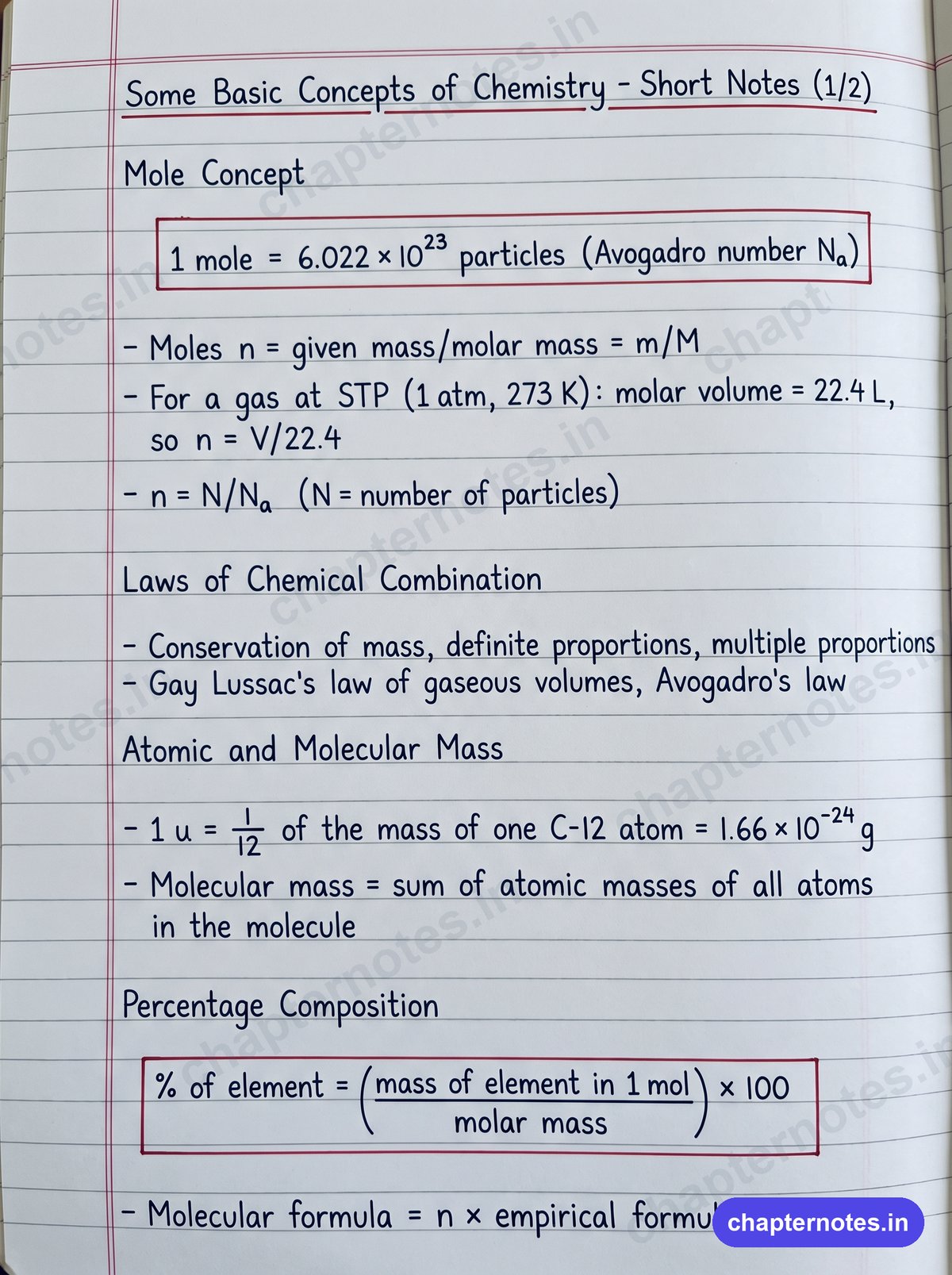
1. Matter and Its Classification
Matter is anything that has mass and occupies space. At the macroscopic level it exists in three physical states - solid, liquid and gas - that can be interconverted by changing temperature and pressure.
Chemically, matter is classified into mixtures and pure substances. A mixture (e.g., air, sugar solution) contains two or more components in any ratio, while a pure substance (e.g., water, gold) has a fixed composition.
- Homogeneous mixture: uniform composition throughout (e.g., salt dissolved in water).
- Heterogeneous mixture: non-uniform composition (e.g., a mixture of sand and iron filings).
- Elements: contain only one kind of atom (e.g., Na, O₂).
- Compounds: two or more elements combined in a fixed ratio by mass (e.g., H₂O, CO₂).
2. Properties and Their Measurement (SI Units)
Physical properties (e.g., density, melting point) can be measured without changing the identity of the substance, while chemical properties (e.g., combustibility) involve a chemical change.
Chemistry uses the SI system of seven base units. The two you use most often are the kilogram (kg) for mass and the mole (mol) for amount of substance.
Precision, Accuracy and Significant Figures
- Accuracy: how close a measured value is to the true value.
- Precision: how close repeated measurements are to one another.
- Significant figures are the meaningful digits known with certainty plus one uncertain digit. All non-zero digits are significant; leading zeros are not; trailing zeros after a decimal are significant.
Rules for calculation: In multiplication/division, the answer has as many significant figures as the term with the fewest. In addition/subtraction, the answer has as many decimal places as the term with the fewest.
3. Laws of Chemical Combination
These five laws govern how elements combine to form compounds and laid the experimental basis for Dalton’s atomic theory.
The Five Laws
- Law of Conservation of Mass (Lavoisier): mass can neither be created nor destroyed in a chemical reaction - total mass of reactants equals total mass of products.
- Law of Definite (Constant) Proportions (Proust): a given compound always contains the same elements in the same fixed proportion by mass (e.g., water is always 1:8 H:O by mass).
- Law of Multiple Proportions (Dalton): when two elements form more than one compound, the masses of one element that combine with a fixed mass of the other are in a simple whole-number ratio (e.g., in CO and CO₂ the oxygen ratio is 1:2).
- Gay Lussac’s Law of Gaseous Volumes: when gases react, they do so in volumes that bear a simple whole-number ratio to one another and to the products, at constant T and P.
- Avogadro’s Law: equal volumes of all gases at the same temperature and pressure contain equal numbers of molecules.
4. Dalton’s Atomic Theory
In 1808 John Dalton proposed the first modern atomic theory, explaining the laws of chemical combination.
- Matter consists of indivisible particles called atoms.
- Atoms of the same element are identical in mass and properties; atoms of different elements differ.
- Atoms combine in simple whole-number ratios to form compounds.
- Atoms are neither created nor destroyed in a chemical reaction.
Key idea: The first two postulates were later modified - atoms are divisible (electrons, protons, neutrons) and isotopes of an element differ in mass.
5. Atomic and Molecular Mass
Atomic mass is the mass of one atom expressed in atomic mass units (u), where 1 u = 1/12 the mass of one carbon-12 atom (1 u = 1.66 × 10⁻²⁴ g).
Average atomic mass accounts for the natural abundance of isotopes. For example, chlorine (75% ³⁵Cl, 25% ³⁷Cl) has average atomic mass = (35 × 0.75) + (37 × 0.25) = 35.5 u.
- Molecular mass: sum of the atomic masses of all atoms in a molecule (e.g., H₂O = 2 × 1 + 16 = 18 u).
- Formula mass: used for ionic compounds that exist as lattices, not molecules (e.g., NaCl = 23 + 35.5 = 58.5 u).
6. The Mole Concept and Molar Mass
One mole is the amount of substance that contains exactly 6.022 × 10²³ elementary entities (atoms, molecules, ions). This number is Avogadro’s number (Nₐ).
The molar mass is the mass of one mole of a substance in grams. Numerically it equals the atomic/molecular mass in u (e.g., molar mass of H₂O = 18 g/mol).
The Master Conversion Formulae
- Number of moles, n = given mass (m) / molar mass (M)
- Number of particles = n × Nₐ = (m/M) × 6.022 × 10²³
- For a gas at STP (273.15 K, 1 bar): volume = n × 22.7 L (22.4 L at 1 atm).
Key idea: The mole is the bridge that connects the mass you weigh in the lab to the number of atoms reacting at the particle level.
7. Percentage Composition
The percentage composition tells you the mass percent of each element in a compound, useful for checking purity and finding formulae.
Mass % of an element = (mass of element in 1 mole of compound / molar mass of compound) × 100
For example, in water (M = 18): mass % of H = (2/18) × 100 = 11.1%, and mass % of O = (16/18) × 100 = 88.9%.
8. Empirical and Molecular Formula
The empirical formula gives the simplest whole-number ratio of atoms in a compound. The molecular formula gives the actual number of atoms in one molecule.
Molecular formula = n × empirical formula, where n = molecular mass / empirical formula mass.
Steps to Find the Empirical Formula
- Convert the mass % of each element to moles (divide by atomic mass).
- Divide all mole values by the smallest one to get the simplest ratio.
- If needed, multiply to obtain whole numbers - these become the subscripts.
For example, a compound that is 40% C, 6.7% H and 53.3% O gives the empirical formula CH₂O; if its molecular mass is 180, then n = 180/30 = 6, so the molecular formula is C₆H₁₂O₆ (glucose).
9. Stoichiometry and Stoichiometric Calculations
Stoichiometry is the quantitative relationship between reactants and products in a balanced chemical equation. The coefficients give the mole ratio in which species react.
Consider: CH₄ + 2O₂ → CO₂ + 2H₂O. This reads: 1 mole of CH₄ reacts with 2 moles of O₂ to give 1 mole of CO₂ and 2 moles of H₂O.
Steps for a Stoichiometry Problem
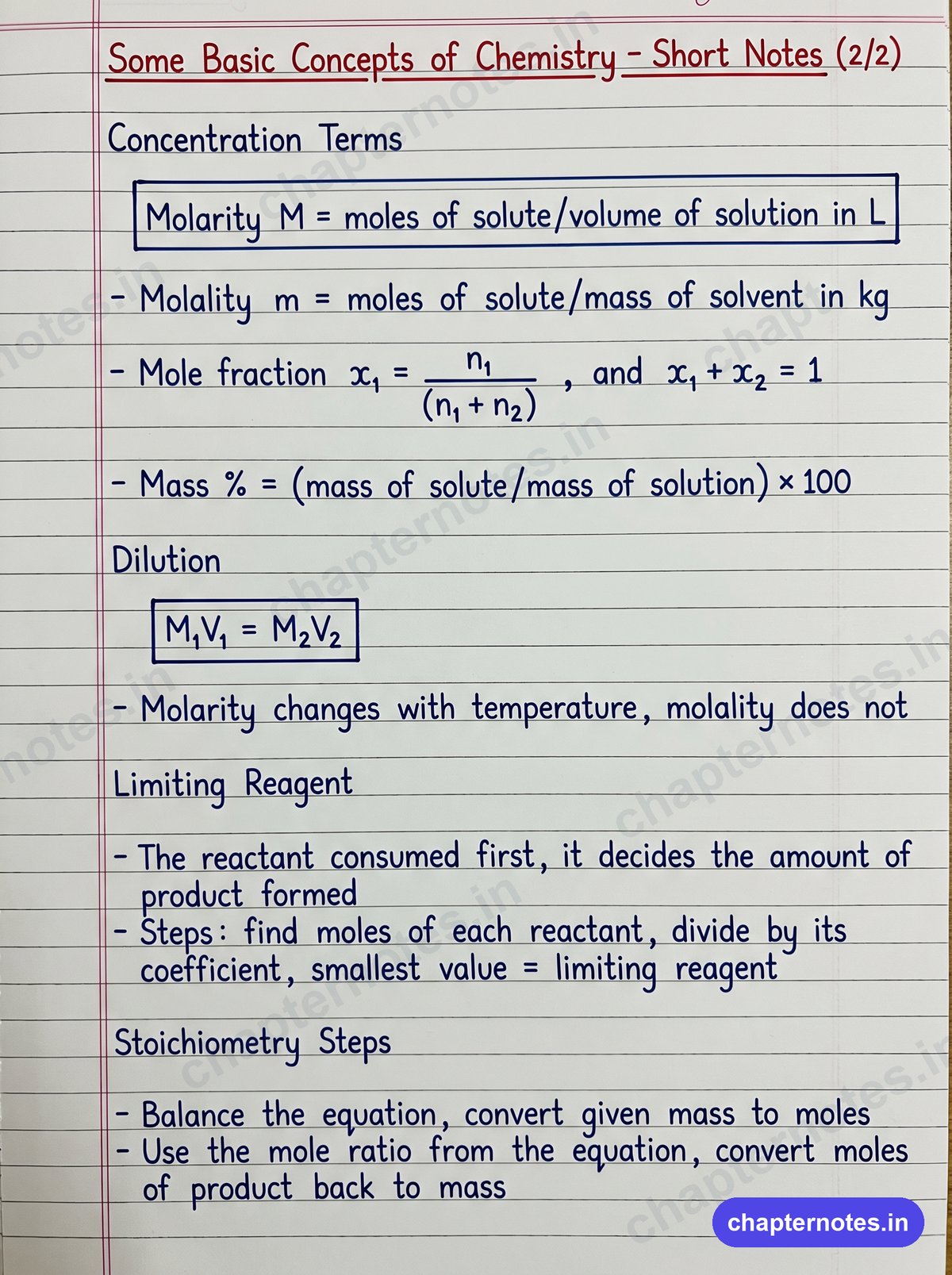
- Write and balance the chemical equation.
- Convert the given quantity to moles.
- Use the mole ratio from the equation to find moles of the required species.
- Convert moles back to mass, volume, or number of particles as asked.
10. Limiting Reagent
The limiting reagent is the reactant that is completely consumed first and therefore decides the maximum amount of product formed. The other reactant(s) are left over in excess.
Method: Find the moles of each reactant, divide each by its stoichiometric coefficient, and the smallest value identifies the limiting reagent.
Key idea: Product yield is always calculated from the limiting reagent, never from the excess reactant - a common board-exam trap.
11. Concentration Terms (Methods of Expressing Concentration)
The concentration of a solution tells you how much solute is dissolved in a given amount of solvent or solution. CBSE focuses on four temperature-independent or temperature-dependent terms.
| Term | Definition | Formula |
|---|---|---|
| Mass percent (% w/w) | Mass of solute per 100 g of solution | (mass of solute / mass of solution) × 100 |
| Molarity (M) | Moles of solute per litre of solution (temperature-dependent) | M = moles of solute / volume of solution (L) |
| Molality (m) | Moles of solute per kg of solvent (temperature-independent) | m = moles of solute / mass of solvent (kg) |
| Mole fraction (x) | Moles of a component per total moles | x_A = n_A / (n_A + n_B) |
Note: Molality and mole fraction are independent of temperature because they use mass, not volume; molarity changes with temperature because volume expands on heating. The sum of mole fractions of all components equals 1.
Read the rest of the chapter →Hide the rest ↑
Weightage in Board & Entrance Exams
| Exam | Typical Weightage | Most-Tested Areas |
|---|---|---|
| CBSE Board (Class 11) | 6–8 marks | Mole concept, stoichiometry, concentration terms, empirical formula |
| JEE Main / Advanced | 2–3 questions | Limiting reagent, molarity/molality interconversion, % yield |
| NEET | 2–3 questions | Mole concept, significant figures, laws of combination |
[TABLE: Question-type split - VSA (1 mark): definitions, laws, units; SA (2–3 marks): mole/mass conversions, concentration calculations, significant figures; LA (5 marks): empirical-to-molecular formula derivations, limiting-reagent numericals.]
Important Definitions
| Term | Definition |
|---|---|
| Mole | Amount of substance containing 6.022 × 10²³ elementary entities |
| Avogadro’s number (Nₐ) | Number of particles in one mole = 6.022 × 10²³ |
| Molar mass | Mass of one mole of a substance in grams |
| Atomic mass unit (u) | 1/12 the mass of one carbon-12 atom |
| Law of conservation of mass | Mass is neither created nor destroyed in a chemical reaction |
| Law of definite proportions | A compound always has the same elements in the same mass ratio |
| Empirical formula | Simplest whole-number ratio of atoms in a compound |
| Limiting reagent | Reactant fully consumed first, deciding the amount of product |
| Molarity (M) | Moles of solute per litre of solution |
| Molality (m) | Moles of solute per kilogram of solvent |
Solved Examples
Example 1
Calculate the number of moles and the number of molecules in 36 g of water (H₂O).
Answer: Molar mass of H₂O = 18 g/mol. n = m/M = 36/18 = 2 mol. Number of molecules = 2 × 6.022 × 10²³ = 1.2044 × 10²⁴ molecules.
Example 2
How many grams of sodium are present in 0.5 mole of Na? (atomic mass of Na = 23)
Answer: m = n × M = 0.5 × 23 = 11.5 g.
Example 3
A compound contains 4.07% H, 24.27% C and 71.65% Cl. Its molar mass is 98.96 g/mol. Find the molecular formula.
Answer: Moles → H: 4.07/1 = 4.07; C: 24.27/12 = 2.02; Cl: 71.65/35.5 = 2.02. Divide by 2.02 → H:2, C:1, Cl:1. Empirical formula = CH₂Cl (mass = 49.48). n = 98.96/49.48 = 2. Molecular formula = C₂H₄Cl₂.
Example 4
Calculate the molarity of a solution containing 5 g of NaOH dissolved in 450 mL of solution. (molar mass NaOH = 40)
Answer: Moles of NaOH = 5/40 = 0.125 mol. Volume = 0.450 L. M = 0.125/0.450 = 0.278 mol/L.
Example 5
In the reaction N₂ + 3H₂ → 2NH₃, if 4 mol of N₂ react with 9 mol of H₂, identify the limiting reagent and the moles of NH₃ formed.
Answer: N₂: 4/1 = 4; H₂: 9/3 = 3. H₂ has the smaller value, so H₂ is the limiting reagent. NH₃ formed = 9 × (2/3) = 6 mol.
Example 6
Calculate the mass percent of carbon in carbon dioxide (CO₂).
Answer: Molar mass of CO₂ = 12 + (2 × 16) = 44. Mass % of C = (12/44) × 100 = 27.27%.
Important Questions for Board Exams
1-Mark Questions (VSA)
- Define one mole of a substance.
- State the law of conservation of mass.
- How many significant figures are present in 0.00250?
- What is the SI unit of amount of substance?
- Why is molality preferred over molarity in temperature-dependent experiments?
2–3-Mark Questions (SA)
- State the law of multiple proportions and illustrate it with the oxides of carbon (CO and CO₂).
- Calculate the number of atoms in 0.1 mole of H₂SO₄.
- Distinguish between empirical formula and molecular formula with one example each.
- Define molarity and mole fraction, and state which is temperature-independent and why.
5-Mark Questions (LA)
- State and explain the five laws of chemical combination with one example for each.
- A compound has 40% C, 6.7% H and 53.3% O with molar mass 180. Derive its empirical and molecular formula.
- Explain the concept of limiting reagent. For the reaction 2H₂ + O₂ → 2H₂O, if 10 g of H₂ reacts with 64 g of O₂, find the limiting reagent and the mass of water produced.
Quick Revision Points
- Matter → mixtures (homogeneous/heterogeneous) and pure substances (elements/compounds)
- Five laws of combination: conservation of mass, definite proportions, multiple proportions, Gay Lussac, Avogadro
- 1 mole = 6.022 × 10²³ particles = Avogadro’s number (Nₐ)
- n = m/M; number of particles = (m/M) × Nₐ; gas at STP occupies 22.7 L/mol
- Molar mass (g/mol) is numerically equal to molecular mass (u)
- Mass % of element = (mass of element / molar mass) × 100
- Empirical = simplest ratio; molecular = n × empirical, n = molecular mass / empirical mass
- Limiting reagent decides product yield - divide moles by coefficients, pick the smallest
- Molarity = mol/L (temperature-dependent); molality = mol/kg solvent (temperature-independent)
- Mole fraction x_A = n_A/(n_A + n_B); sum of all mole fractions = 1
- Significant figures: multiplication/division → fewest sig figs; addition/subtraction → fewest decimal places
Next Chapter: Chapter 2 - Structure of Atom
The number of moles of hydrogen molecules required to produce 20 moles of ammonia through Haber’s process is:
20
30
40
10
N₂ + 3H₂ arrow 2NH₃: 2 moles NH₃ require 3 moles H₂, so 1 mole NH₃ requires 3/2 moles H₂. For 20 moles NH₃, H₂ = (3/2) × 20 = 30 moles.
One mole of a carbon atom weighs 12 g. The number of atoms in it is equal to (mass of carbon-12 is 1.9926×10⁻²³ g):
1.2×10²³
6.022×10²²
12×10²³
6.022×10²³
By definition, 12 g of carbon (one mole of carbon atoms) contains the Avogadro number of atoms, 6.022×10²³. (Check: 12 / 1.9926×10⁻²³ = 6.022×10²³.)
Elements X and Y combine to form two compounds XY₂ and X₃Y₂. When 0.1 mol of XY₂ weighs 10 g and 0.05 mol of X₃Y₂ weighs 9 g, the atomic weights of X and Y respectively (in g mol⁻¹) are:
40, 30
60, 40
20, 30
30, 20
Molar mass of XY₂ = 10/0.1 = 100, so A_X + 2A_Y = 100. Molar mass of X₃Y₂ = 9/0.05 = 180, so 3A_X + 2A_Y = 180. Subtracting: 2A_X = 80 → A_X = 40, then A_Y = (100 − 40)/2 = 30. Hence A_X = 40, A_Y = 30.
An organic compound contains 78% (by weight) carbon and the remaining percentage of hydrogen. The empirical formula of this compound is (atomic masses: C = 12, H = 1):
CH
CH₂
CH₃
CH₄
%H = 100 − 78 = 22. Relative moles: C = 78/12 = 6.5; H = 22/1 = 22. Divide by the smaller (6.5): C = 1, H = 22/6.5 ≈ 3.4 ≈ 3. Empirical formula = CH₃.
If the Avogadro number N_A is changed from 6.022×10²³ mol⁻¹ to 6.022×10²⁰ mol⁻¹, this would change:
the definition of mass in units of grams
the mass of one mole of carbon
the ratio of chemical species to each other in a balanced equation
the ratio of elements to each other in a compound
The mass of one mole = (number of atoms in a mole) × (mass of one atom). With N_A reduced by 10³, one mole of carbon would contain 10³ times fewer atoms, so its mass becomes 12/10³ ≈ 0.012 g. The atom-to-atom ratios in formulae and balanced equations are independent of N_A.
Class 11 Chemistry · Chapter 1 – swipe through all 8 cards to understand the whole chapter.
The Mole & Avogadro Number
A mole is just a fixed count of particles, like a dozen is always 12.
Always convert mass, particles or volume into moles FIRST.
- 1 mole of atoms/molecules/ions = 6.022 × 10²³ of those particles.
- Watch atomicity: 1 mol O2 has 2 mol O atoms = 2 × 6.022 × 1023 atoms.
- 1 mole of an ideal gas at STP (273.15 K, 1 bar) occupies 22.7 L.
Three Bridges to the Mole
Mass, number of particles and gas volume all connect through moles.
Old NCERT used 22.4 L at 1 atm; new uses 22.7 L at 1 bar.
- Mass → moles: divide by molar mass (g mol⁻1).
- Particles → moles: divide by 6.022 × 10²³.
- Gas volume at STP → moles: divide by 22.7 L.
Atomic, Molecular & Molar Mass
All masses are measured relative to carbon-12, fixed at exactly 12 u.
1 u = 1.66 × 10⁻24 g; molar mass is the same number in g mol⁻1.
- Molecular mass = sum of atomic masses, e.g. H2O = 2(1) + 16 = 18 u.
- Formula mass is used for ionic solids, e.g. NaCl = 58.5 u.
- Cl: 35(0.75) + 37(0.25) = 35.5 u — use abundance as a fraction.
Percentage Composition
What fraction of a compound’s mass comes from each element.
Use it as the starting point for finding empirical formulae.
- Compute the element’s mass in one mole, then divide by molar mass.
- H2O: H = 2/18 × 100 ≈ 11.1%, O = 16/18 × 100 ≈ 88.9%.
- The percentages of all elements must add up to 100%.
Empirical vs Molecular Formula
Empirical is the simplest atom ratio; molecular is the actual count.
Divide each element’s mass by ATOMIC mass, never by molar mass.
- Divide % (or mass) of each element by its atomic mass → relative moles.
- Divide all by the smallest value → simplest whole-number ratio.
- 40% C, 6.7% H, 53.3% O → CH2O (mass 30); if M = 180, n = 6 → C6H12O6.
Stoichiometry & Limiting Reagent
A balanced equation gives the mole recipe; the reactant that runs out caps the product.
Yield is ALWAYS calculated from the limiting reagent, not the excess.
- Convert each reactant to moles, divide by its coefficient.
- Smallest value = limiting reagent; it decides maximum product.
- Percent yield = (actual / theoretical) × 100.
Concentration Terms
Several ways to state how much solute sits in a solution.
Only molality and mole fraction are temperature-independent.
- Molarity uses solution VOLUME; molality uses solvent MASS.
- Mole fraction: x_A + x_B = 1; mass % = (mass solute / mass soln) × 100.
- Link: M = (10 × d × %w/w) / molar mass, with d in g mL⁻1.
Significant Figures & SI Units
Significant figures show how trustworthy a measured number is.
Round only the FINAL answer; exact/counted numbers have infinite s.f.
- Non-zero digits and zeros between them count; leading zeros don’t.
- Trailing zeros after a decimal count: 2.500 → 4 s.f., 0.0025 → 2 s.f.
- SI base units: kg, m, s, mol, K, A, cd; use the factor-label method.
📝 Practice Some Basic Concepts of Chemistry — 10 NEET PYQs
Real previous-year questions · with answers & solutions
Start →Close ✕
Chapter Navigation
Previous: This is the first chapter of Class 11 Chemistry.
Next: Structure of Atom Class 11 Notes
Related Chapters in Class 11 Chemistry
- Structure of Atom Class 11 Notes
- Organic Chemistry: Some Basic Principles and Techniques Class 11 Notes
- Class 11 Chemistry Notes Hub
Practice What You Learned
Take your physical chemistry further with our Class 12 Chemistry notes once you are board-ready.
Explore More
Frequently Asked Questions
A mole is a fixed count of particles, just like a dozen always means 12. One mole contains the Avogadro number, 6.022 times 10 to the power 23 particles, and the mass of one mole of a substance in grams equals its molar mass.
Convert each reactant’s given amount into moles, then divide each by its coefficient in the balanced equation. The reactant giving the smallest value is the limiting reagent, and the maximum product is always calculated from it, not from the excess reactant.
The empirical formula is the simplest whole-number ratio of atoms in a compound, while the molecular formula is the actual number of atoms present. They are linked by n equal to molecular mass divided by empirical formula mass, so glucose has empirical formula CH2O and molecular formula C6H12O6 with n equal to 6.
Molarity is moles of solute per litre of solution and changes with temperature because volume expands, while molality is moles of solute per kilogram of solvent and is temperature-independent. Mole fraction is also temperature-independent since it depends only on amounts of substance.
It is one of the most scoring Physical Chemistry chapters and usually contributes one to two direct NEET questions, often calculation based on moles, stoichiometry, or concentration. Mastering it is essential because the mole concept and unit handling are used throughout the rest of the Chemistry syllabus.
